
The Peterson reaction and related processes
In the Peterson reaction an α-silyl carbanion adds to an aldehyde or a ketone and forms a β-hydroxysilane, which eliminates Me3SiOH to give the alkene. It is the silicon equivalent of the Wittig reaction, and its advantage is that the same intermediate gives either the E or the Z alkene depending on whether elimination is carried out under acidic or basic conditions.
Addition and elimination
Silicon stabilizes a negative charge on the adjacent carbon, so α-silyl carbanions form easily, by deprotonation or, more often, from the halides: (trimethylsilyl)methyllithium and (trimethylsilyl)methylmagnesium chloride are commercial reagents. Their addition to the carbonyl gives the alkoxide of the β-hydroxysilane.
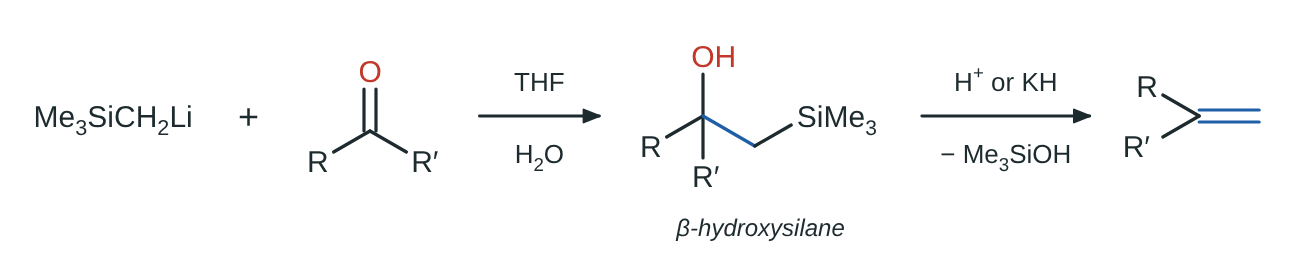
If the counterion is potassium or sodium the alkoxide eliminates spontaneously; with lithium, and especially with magnesium, the O–metal bond is more covalent, the alkoxide is stable and the β-hydroxysilane can be isolated and purified, even separating its diastereomers. The by-product, hexamethyldisiloxane, is volatile, which simplifies purification of the alkene. For the simple methylenation of hindered or enolizable ketones the Peterson reaction often works better than the Wittig reaction, because the reagent is less basic.
Control of the alkene geometry
Elimination from the β-hydroxysilane can be carried out in two ways with opposite stereochemistry:
- Under acidic conditions (H2SO4, BF3·OEt2, AcOH) the protonated hydroxyl leaves with the silyl group in an anti arrangement, as in an E2 elimination.
- Under basic conditions (KH, NaH) the alkoxide attacks silicon and forms a four-membered ring (a 1,2-oxasiletanide) that fragments like the oxaphosphetane of the Wittig reaction: elimination is syn.
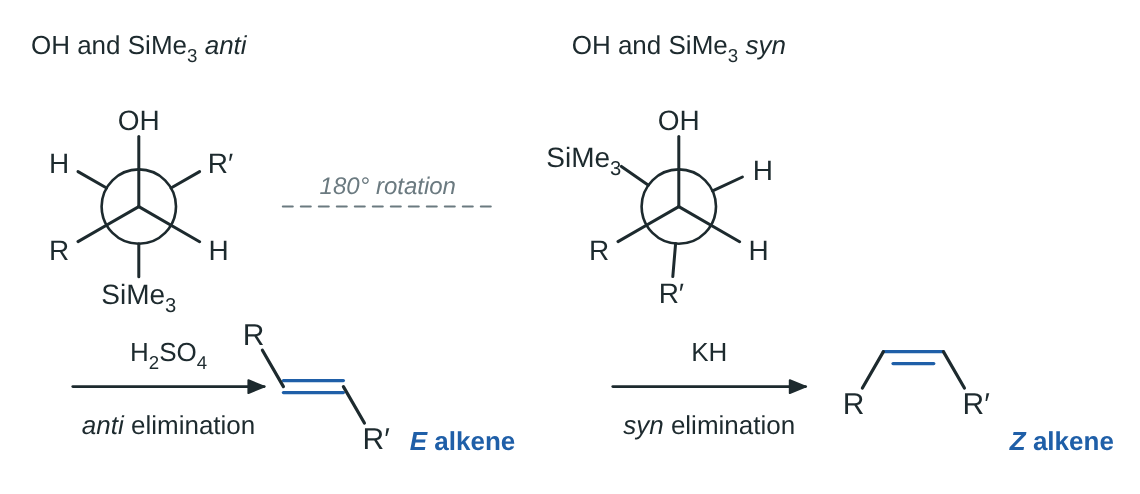
A single diastereomer of the β-hydroxysilane therefore gives access to either alkene. The practical problem lies in preparing that diastereomer pure, since addition of the silyl carbanion to the aldehyde is poorly stereoselective; it is achieved, for example, by adding an organometallic reagent to an α-silyl ketone under Felkin–Anh control, or by separating the diastereomers.
The reaction was described by Donald J. Peterson in 1968. Compare it with the Wittig reaction and with the pyrolytic syn eliminations, and review E2 eliminations in Organic Chemistry made transparent.