
Reactivity
Phenols have two reactive centres: the OH group, more acidic than that of alcohols, and a very electron-rich aromatic ring. The C–O bond, on the other hand, is not broken: phenols do not undergo nucleophilic substitution or elimination of the OH. Their chemistry is that of oxygen as a nucleophile and that of electrophilic aromatic substitution (SEAr) at the ortho and para positions.
Reactions of the OH group
Acidity: formation of phenoxides
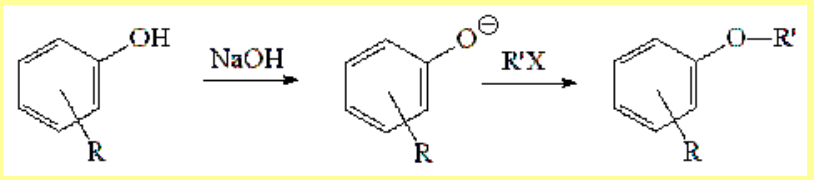
With a pKa of about 10, phenols are converted quantitatively into phenoxides by sodium hydroxide, but not by bicarbonate (see the acid-base properties). The phenoxide ion is a better nucleophile than phenol and is the starting reagent for almost all the reactions at oxygen.
Ether formation: Williamson synthesis
Phenoxide attacks a primary alkyl halide (or a dialkyl sulfate) by an SN2 mechanism to give an alkyl aryl ether; anisole (methoxybenzene) is prepared in this way from phenol and methyl iodide. The halide must be an alkyl halide: diaryl ethers cannot be obtained in this way, because aryl halides do not undergo SN2 (more information in the preparation of ethers).
Ester formation
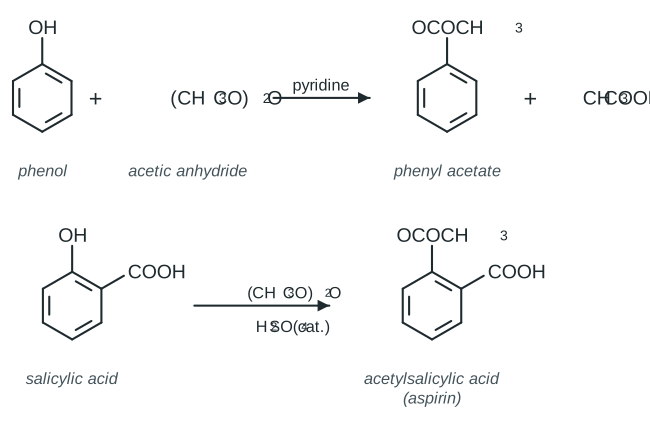
Phenols are poorer nucleophiles than alcohols and Fischer esterification with carboxylic acids hardly proceeds. Phenyl esters are prepared with more reactive acylating reagents, acid chlorides or anhydrides, in the presence of a base (pyridine or NaOH). Acetylation of salicylic acid with acetic anhydride gives aspirin (see also esterification).
The Ar–O bond is much stronger than the C–O bond of an alcohol, because oxygen is bonded to an sp2 carbon and conjugates its lone pairs with the ring. That is why HBr or HI do not convert phenol into an aryl halide, and why cleavage of an alkyl aryl ether such as anisole always gives the phenol and the alkyl halide.
Electrophilic aromatic substitution
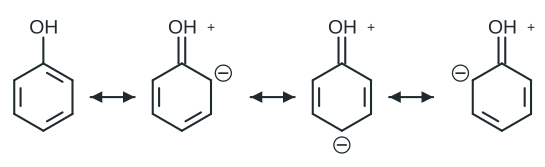
The OH group donates electron density to the ring by resonance and makes it much more reactive than benzene towards electrophiles. The resonance structures show that negative charge builds up at the ortho and para positions, which are the ones that attack electrophiles. The phenoxide ion, with a full negative charge on oxygen, is even more reactive.
Halogenation
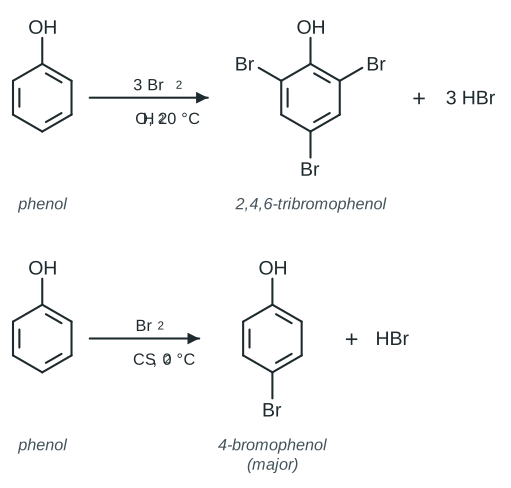
Phenol reacts with bromine water at room temperature, with no need for a Lewis acid catalyst, and all three activated positions are substituted: 2,4,6-tribromophenol precipitates as a white solid. To stop the reaction at monobromination, the conditions must be moderated: with bromine in a non-polar solvent (CS2) at low temperature, mainly 4-bromophenol is obtained.
Nitration
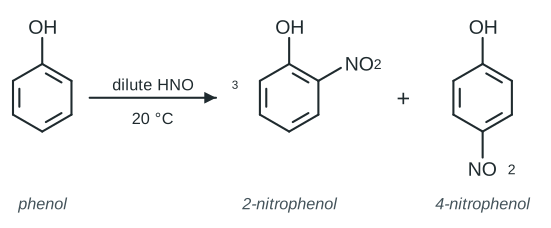
Dilute nitric acid at room temperature is enough to nitrate phenol, and a mixture of 2-nitrophenol and 4-nitrophenol is obtained. The two isomers are separated by steam distillation: the ortho isomer forms an intramolecular hydrogen bond, is more volatile and distils; the para isomer, associated by intermolecular hydrogen bonds, stays in the flask. With concentrated nitric acid phenol is largely oxidized, so 2,4,6-trinitrophenol (picric acid) is prepared by first sulfonating phenol and then nitrating it.
Sulfonation
Phenol is easily sulfonated by concentrated sulfuric acid. Since sulfonation is reversible, temperature decides the product: at room temperature ortho-hydroxybenzenesulfonic acid predominates (kinetic product), and at 100 °C the more stable para isomer (thermodynamic product).
Carboxylation: Kolbe-Schmitt reaction
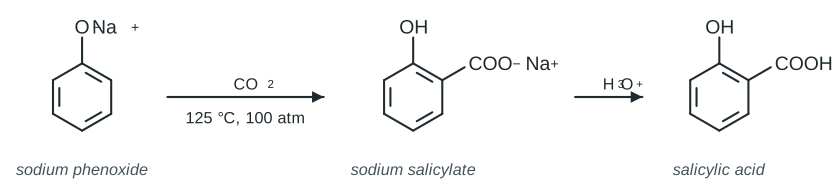
Sodium phenoxide is so nucleophilic that it reacts with an electrophile as weak as carbon dioxide (at about 125 °C and 100 atm). Attack takes place at the ortho position and, after acidification, salicylic acid (2-hydroxybenzoic acid), the raw material for aspirin, is obtained.
Oxidation to quinones
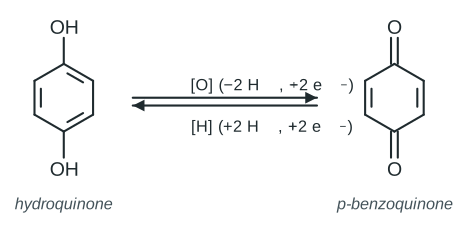
Unlike alcohols, phenols have no hydrogen on the carbon bearing the OH, but they are easily oxidized at the ring to give quinones (cyclohexadienediones). Hydroquinone (1,4-benzenediol) is oxidized to p-benzoquinone by mild oxidants and the process is reversible: the quinone is reduced back to hydroquinone. This redox pair is the basis of photographic development (hydroquinone reduces Ag+ ions to silver) and of biological electron carriers such as ubiquinone (coenzyme Q).
The same ease of oxidation makes many phenols antioxidants: they give the OH hydrogen to free radicals and form resonance-stabilized phenoxyl radicals, which do not propagate the chain. This is how BHT, added to foods and plastics, and vitamin E (α-tocopherol) in cell membranes work.
Ferric chloride test
Most phenols give an intense colour, from violet to blue or green, with a dilute FeCl3 solution, due to the formation of iron(III) complexes with the phenoxide ion. Alcohols do not give this colour, so it is a simple test to recognize a phenol.