Preparation
Phenols cannot be prepared like alcohols. Aryl halides do not undergo SN1 or SN2 reactions under ordinary conditions, and the aromatic ring is not hydrated like an alkene. The OH group is therefore introduced into the ring by its own routes: under very harsh conditions in industry, and through diazonium salts in the laboratory.
Industrial methods
Phenol is one of the organic chemicals produced in largest amounts: it is used mainly to make bisphenol A (polycarbonates and epoxy resins), phenol-formaldehyde resins (Bakelite) and caprolactam (nylon 6). In the 19th century it was extracted from coal tar; three synthetic processes were developed afterwards.
Alkaline fusion of arenesulfonic acids
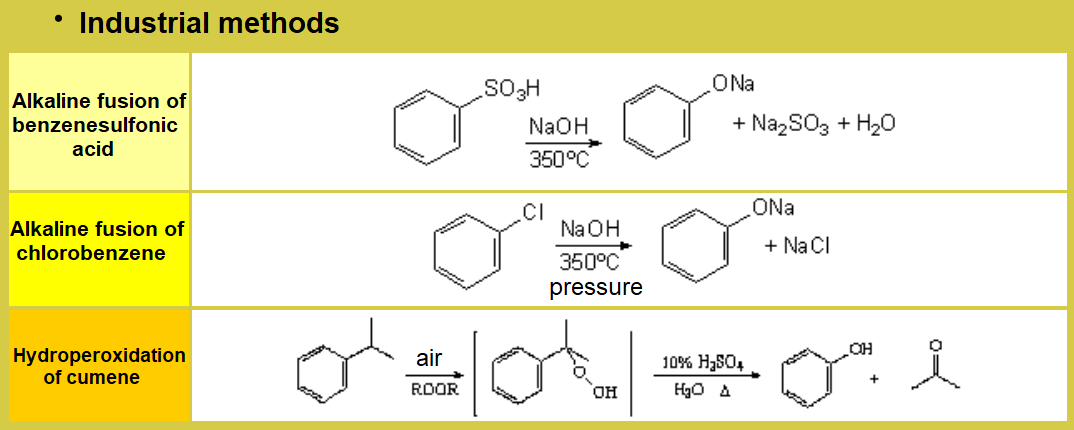
This was the first industrial method. Benzenesulfonic acid (or its sodium salt) is fused with sodium hydroxide at 300–350 °C: the hydroxide ion replaces the sulfonate group and sodium phenoxide is formed, which is acidified to release phenol. The conditions are so harsh that the method only works for arenes without base-sensitive groups.
Hydrolysis of chlorobenzene (Dow process)
Chlorobenzene reacts with aqueous NaOH at about 350 °C and high pressure. This is not a direct substitution: the base removes a proton next to the chlorine, HCl is eliminated and a very reactive intermediate, benzyne (dehydrobenzene), is formed; water or hydroxide then adds to it (elimination-addition mechanism). When the carbon bonded to chlorine is labelled with 14C, the OH ends up shared between that carbon and its neighbour, just as benzyne requires.
Cumene process (Hock)
This is the method by which the vast majority of phenol is made today. It has three stages:
- Acid-catalysed Friedel-Crafts alkylation of benzene with propene, which gives cumene (isopropylbenzene).
- Oxidation of cumene with oxygen from the air, by a free-radical chain reaction: the tertiary benzylic hydrogen is replaced by an –O–O–H group and cumene hydroperoxide is formed.
- Treatment of the hydroperoxide with dilute acid: the phenyl group migrates from carbon to oxygen (Hock rearrangement) and hydrolysis of the intermediate gives phenol and acetone.
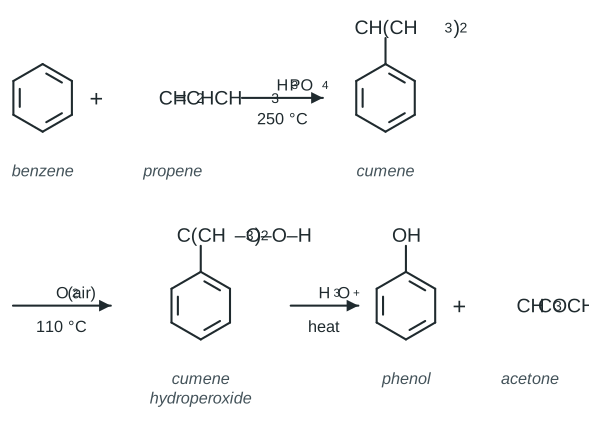
The cumene process is profitable because it uses cheap raw materials (benzene, propene and air) and gives two valuable products: about 600 kg of acetone are obtained for every tonne of phenol.
Laboratory methods
Hydrolysis of arenediazonium salts
This is the general method for introducing an OH into a ring that already carries other substituents. The aromatic amine is treated with sodium nitrite and a mineral acid at 0–5 °C (diazotization) to form the arenediazonium salt, Ar–N2+. When its aqueous solution is heated, nitrogen is released and water takes its place. Sulfuric acid is preferred to hydrochloric acid so that chloride ion does not compete with water.
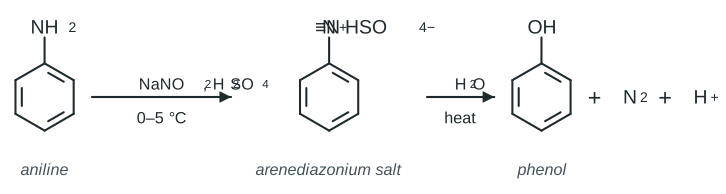
Since aromatic amines are obtained by reducing nitroarenes, the sequence nitration → reduction → diazotization → hydrolysis allows an OH to be placed in almost any position of the ring.
Nucleophilic aromatic substitution (SNAr)
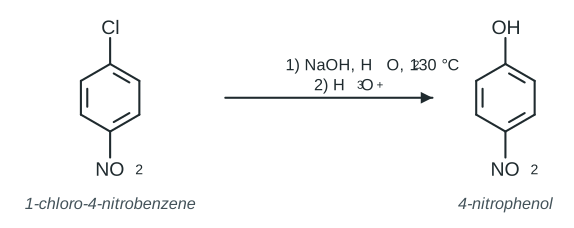
Aryl halides bearing strongly electron-withdrawing groups (NO2) ortho or para to the halogen do react with hydroxide ion. The nucleophile adds to the carbon bearing the halogen to form a carbanion delocalized onto the nitro group (Meisenheimer complex), which then expels the halide. The more nitro groups there are, the milder the conditions: 2,4,6-trinitrochlorobenzene is hydrolysed simply with hot water to give picric acid.