Acid-Base Properties
One of the most characteristic properties of phenols is their 'unexpected', relatively high acidity. Structurally speaking, they are much like alcohols, but phenols are several orders of magnitude more acidic. How come?
| Compound | Acid-base equilibrium | pKa | Reacts with NaHCO3? | Reacts with NaOH? |
|---|---|---|---|---|
| Alcohols | 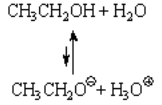 | 16–18 | No | No |
| Phenols | 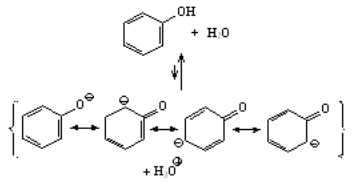 | 8–10 | No | Yes |
| Carboxylic acids | 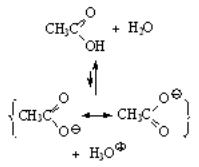 | 3–5 | Yes | Yes |
Alcohols: very weakly acidic
In the alkoxide ion the negative charge stays concentrated on the oxygen, with no way of spreading by resonance. The equilibrium lies far towards the alcohol, and not even a strong base such as NaOH deprotonates it to an appreciable extent.
Phenols: a million times more acidic
In the phenoxide ion the negative charge is shared between the oxygen and the ortho and para carbons of the ring. The forms with the charge on a carbon weigh less in the resonance hybrid, but they are enough to stabilize the anion: a phenol is more than a million times more acidic than an alcohol. That is why NaOH deprotonates it completely in water, although bicarbonate cannot.
Carboxylic acids: the most acidic of the three
The carboxylate ion has two equivalent resonance forms, and in both the negative charge sits on a very electronegative oxygen. The anion is highly stabilized, and carboxylic acids react even with a weak base such as bicarbonate.
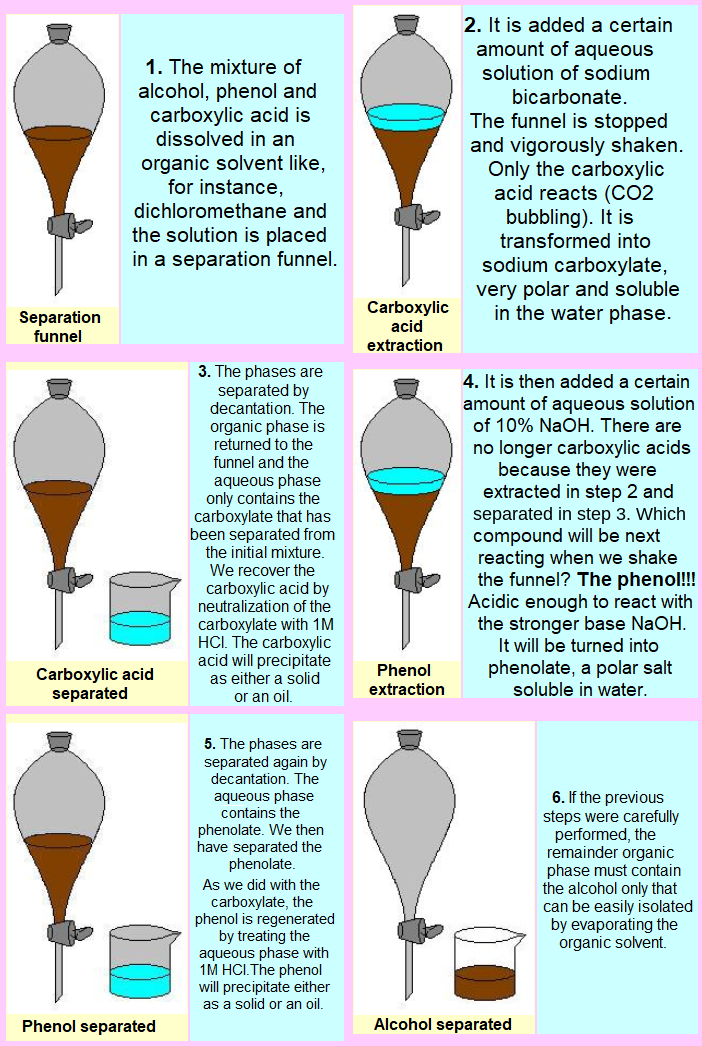
The different acidity of alcohols, phenols and carboxylic acids makes them react differently with NaHCO3 and NaOH, which allows us to separate them easily in the lab. Can you work out how?