
Strategies in asymmetric synthesis
The two enantiomers of a drug, a flavour or a pesticide usually have different biological activities, and the synthesis must give only one. There are four ways of achieving this: starting from an enantiopure natural compound (the chiral pool), separating the enantiomers of a racemate (resolution), temporarily attaching a chiral group to the substrate (an auxiliary) or using a chiral catalyst.
Enantiomeric excess
The purity of a chiral product is expressed as enantiomeric excess, ee = ([R] − [S]) / ([R] + [S]) × 100, or as an enantiomeric ratio (er): a 95:5 mixture has 90% ee. Today it is measured by chromatography (HPLC or GC) on a chiral stationary phase or by NMR of the diastereomers formed by the product with a chiral reagent, such as Mosher’s acid; specific rotation is unreliable for this purpose. Review chirality and optical activity and absolute configuration in Organic Chemistry made transparent.
The two enantiomers are formed through diastereomeric transition states, and the enantiomeric ratio depends exponentially on their free-energy difference, ΔΔG‡ = RT ln(er). A few kJ/mol, less than a hydrogen bond, take the selectivity from modest to excellent, and the same difference gives more ee at low temperature:
| ee | er | ΔΔG‡ at 25 °C | ΔΔG‡ at −78 °C |
|---|---|---|---|
| 50% | 75:25 | 2.7 kJ/mol | 1.8 kJ/mol |
| 80% | 90:10 | 5.4 kJ/mol | 3.6 kJ/mol |
| 90% | 95:5 | 7.3 kJ/mol | 4.8 kJ/mol |
| 98% | 99:1 | 11.4 kJ/mol | 7.5 kJ/mol |
| 99% | 99.5:0.5 | 13.1 kJ/mol | 8.6 kJ/mol |
The chiral pool
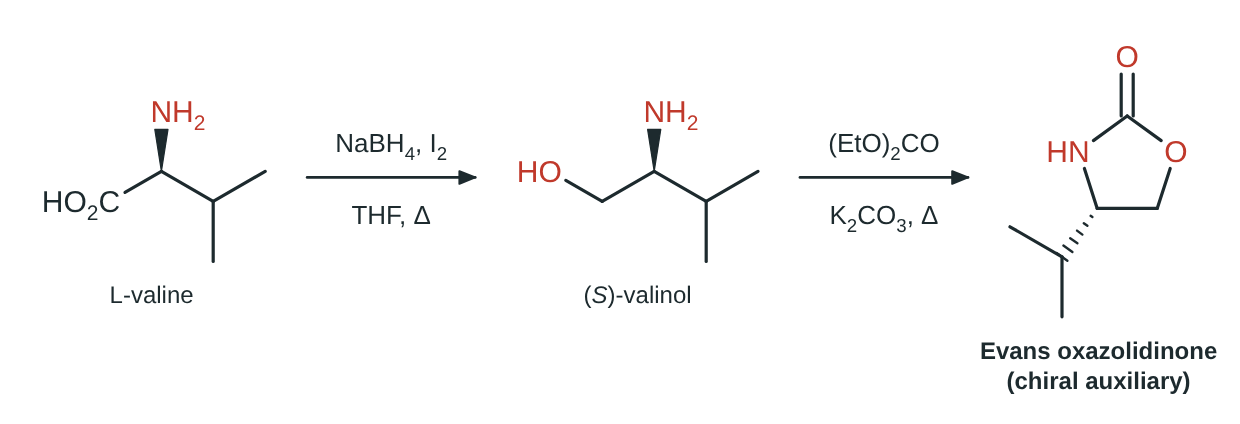
Amino acids, sugars, lactic, malic and tartaric acids, and terpenes such as menthol, α-pinene or carvone are cheap and enantiopure. They can be incorporated into the skeleton of the product or converted into chiral reagents, ligands and auxiliaries. L-Valine, for example, is reduced to valinol, which is cyclized with diethyl carbonate to the oxazolidinone of the Evans auxiliary. The limitation is that nature often offers only one of the two enantiomers.
Resolution
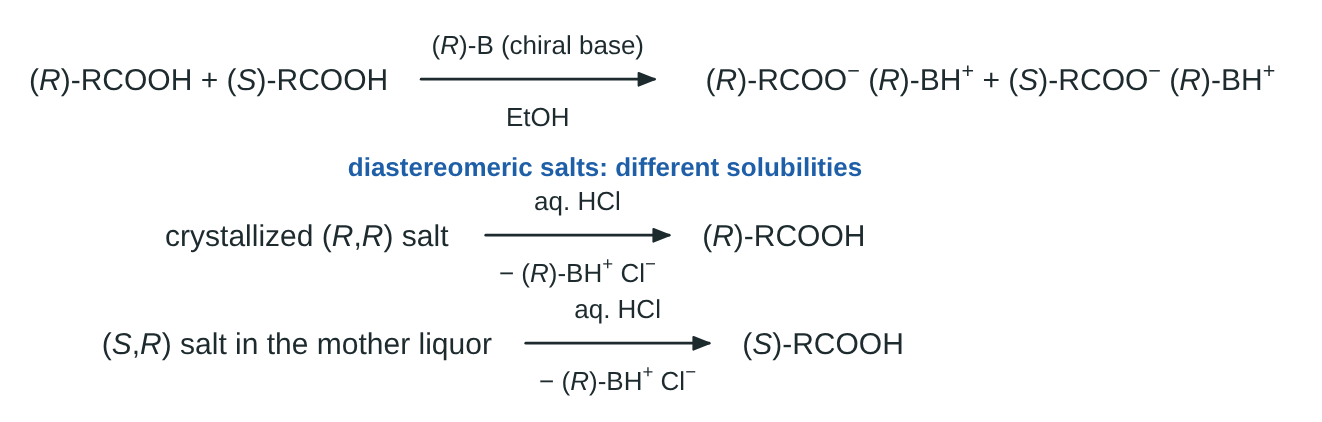
In 1848 Louis Pasteur separated by hand, with tweezers and a magnifying glass, the enantiomorphic crystals of sodium ammonium tartrate. Classical resolution converts the racemate into two diastereomers with an enantiopure compound, for example a chiral base (brucine, 1-phenylethylamine) for an acid: the diastereomeric salts have different solubilities and are separated by crystallization. Its maximum yield is 50%, unless the unwanted enantiomer is racemized and recycled.
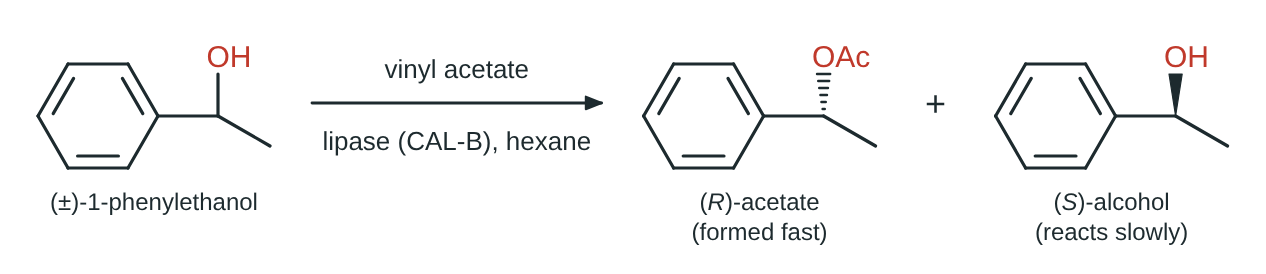
In kinetic resolution, a chiral reagent or catalyst transforms one enantiomer faster than the other. Lipases acetylate secondary alcohols with vinyl acetate, which makes the reaction irreversible by releasing acetaldehyde; Candida antarctica lipase B (CAL-B) preferentially acetylates the R enantiomer of 1-phenylethanol. The larger the ratio of the rates, the better; and if a second catalyst continuously racemizes the starting alcohol (dynamic kinetic resolution), all of the racemate can be converted into the R acetate.
Chiral auxiliaries and catalysts
A chiral auxiliary is attached to the substrate, controls the face from which it reacts and is removed at the end. It makes the reaction diastereoselective, so that the products can be separated by chromatography and their purity is easy to measure; you have already seen them in the Evans alkylation and the Evans aldols. Their drawback is that they require two additional steps and a stoichiometric amount of auxiliary.
A chiral catalyst transmits its stereochemical information to thousands of product molecules. It is the most economical solution and the one studied in the rest of this topic: metal catalysts with chiral ligands (Sharpless and Noyori), small organic molecules (organocatalysis) and, in the limit, the product itself (autocatalysis). Enzymes, nature’s chiral catalysts, are increasingly used in industry.