Thalidomide: why chirality matters
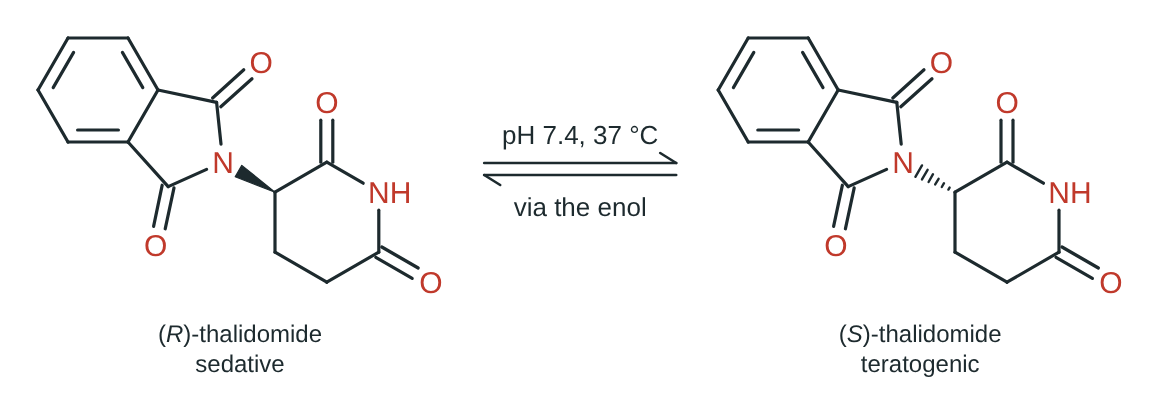
Thalidomide was sold between 1957 and 1961 as a sedative and against morning sickness, as the racemate. It caused severe malformations in more than ten thousand newborns. The sedative effect was later attributed to the R enantiomer and the teratogenic effect to the S, and the case changed drug regulation: since then the two enantiomers must be studied separately.
But giving only the R enantiomer would not have prevented the tragedy. The stereocentre of thalidomide lies between a carbonyl and a nitrogen, and its hydrogen is acidic: at physiological pH it is lost through the enol and the two enantiomers interconvert within a few hours. This is why chiral drugs are designed with configurationally stable stereocentres. Today thalidomide is used, under strict controls, against multiple myeloma and leprosy.