Synthesis of the sartan intermediate
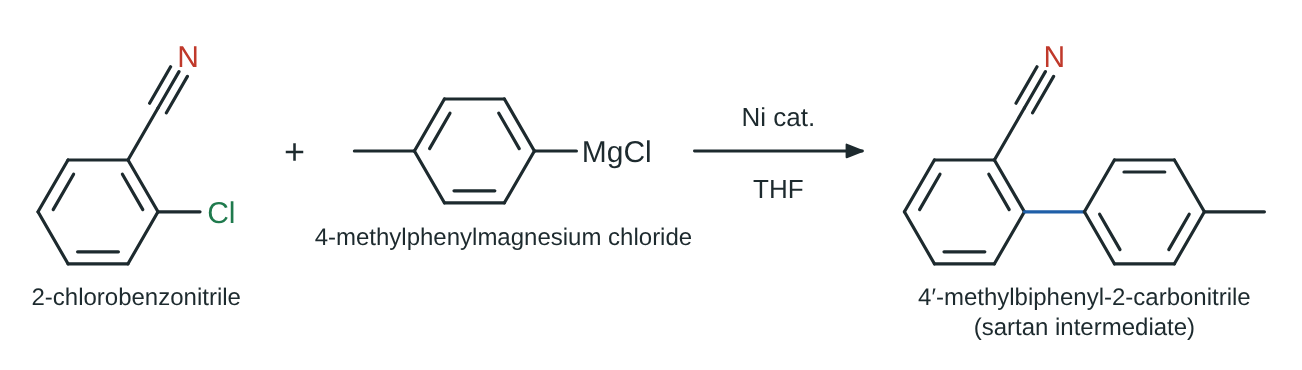
The sartans (losartan, valsartan, irbesartan…) are antihypertensive drugs that share a biphenyl skeleton bearing a tetrazole. 4′-Methylbiphenyl-2-carbonitrile is their common intermediate: the nitrile is later converted into the tetrazole and the methyl group, after bromination, is used to attach the rest of the molecule.
One of the industrial routes is a Kumada coupling between 2-chlorobenzonitrile and 4-methylphenylmagnesium chloride, with a nickel catalyst. The Grignard reagent attacks the C–Cl bond, by the catalytic pathway, faster than the nitrile.