
The Negishi, Stille and Kumada couplings
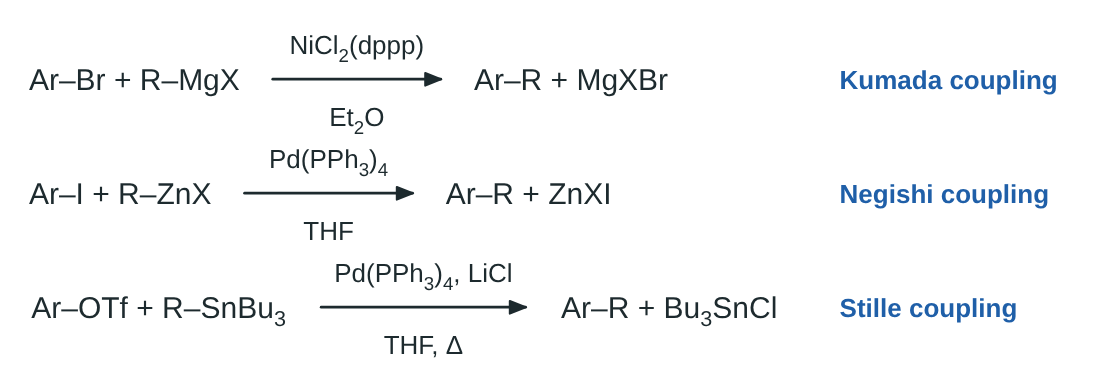
The Kumada, Negishi and Stille couplings follow the same cycle as the Suzuki coupling, but the organic group reaches palladium (or nickel) from magnesium, zinc or tin. The choice of metal is a compromise between reactivity and functional-group tolerance.
The Kumada coupling
It was the first of the catalytic couplings (Makoto Kumada and Kohei Tamao, and independently Robert Corriu, 1972). It uses Grignard reagents directly, which are cheap and easy to prepare, with nickel catalysts such as NiCl2(dppp) or palladium catalysts. Its limitation is that of the Grignard reagents themselves: they do not tolerate aldehydes, ketones, esters or groups with acidic hydrogens.
The Negishi coupling
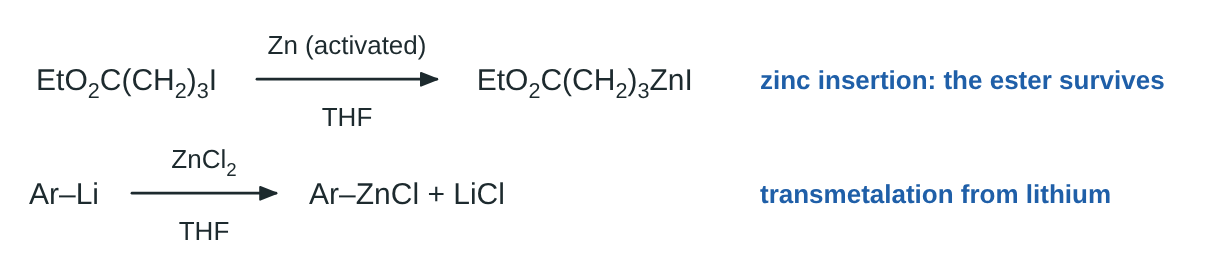
Organozinc reagents are less polar than Grignard reagents and tolerate esters, nitriles and ketones, yet they transmetalate to palladium very rapidly. They are prepared by insertion of activated zinc into alkyl iodides or by transmetalation from an organolithium or a Grignard reagent with ZnCl2. The Negishi coupling (1977) is particularly useful for joining sp3 carbons; its drawback is the sensitivity of the reagents to air and water.
The Stille coupling
Organostannanes (R–SnBu3, R–SnMe3) are stable to air and water, can be purified by chromatography and tolerate practically every functional group, so the Stille coupling (John K. Stille and David Milstein, 1978) has been widely used in the synthesis of complex natural products. Only one of the four groups on tin is transferred: alkyl groups migrate much more slowly than alkynyl, vinyl and aryl groups. LiCl and copper(I) salts accelerate transmetalation. Its great drawback is the toxicity of tin compounds and the difficulty of removing their residues from the product.
Review the preparation of Grignard reagents and organolithiums in the first section of this topic.