
The Buchwald-Hartwig amination
The Buchwald–Hartwig amination forms C–N bonds between an aryl halide or triflate and a primary or secondary amine, with a palladium catalyst, a bulky phosphine and a strong base. It has replaced the classical methods for preparing arylamines, which required harsh conditions or activated rings.
The reaction

Before this reaction, arylamines were prepared by nitration and reduction, which gives only primary amines and depends on the orientation of electrophilic aromatic substitution, or by nucleophilic aromatic substitution, which requires electron-withdrawing groups in the ortho or para positions. The palladium coupling works with rings of any kind.
Mechanism and ligands
After oxidative addition, the amine coordinates to palladium and the base deprotonates it to form a palladium amido complex; reductive elimination forms the C–N bond. This elimination competes with β-hydride elimination from the amido group, which would reduce the aryl halide to the arene. Bulky, electron-rich phosphines (BINAP and dppf in the early work; later dialkylbiarylphosphines such as XPhos, SPhos or BrettPhos) accelerate reductive elimination and allow aryl chlorides to be used.
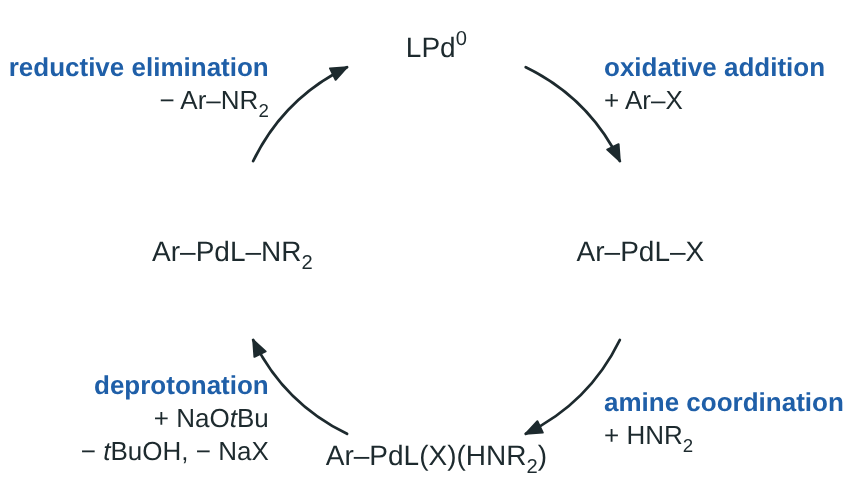
With suitable ligands alcohols and phenols (aryl ether synthesis), amides and heterocyclic amines can also be coupled. A cheaper, copper-based alternative is the Ullmann–Goldberg coupling.
The reaction was developed independently by Stephen L. Buchwald and John F. Hartwig from 1994 onwards, building on a precedent by Masanori Kosugi and Toshihiko Migita (1983) with tin amides.