
The Sonogashira coupling
The Sonogashira coupling joins a terminal alkyne with an aryl or vinyl halide using a palladium catalyst and a copper(I) salt in an amine. It is the most direct method for preparing arylalkynes and conjugated enynes.
The reaction

The conditions are very mild: with iodides the reaction usually proceeds at room temperature. The amine acts as the base and, often, as the solvent. Oxygen must be excluded, because copper catalyses the oxidative coupling of two alkynes (Glaser coupling), which gives the diyne as a by-product.
Two catalytic cycles
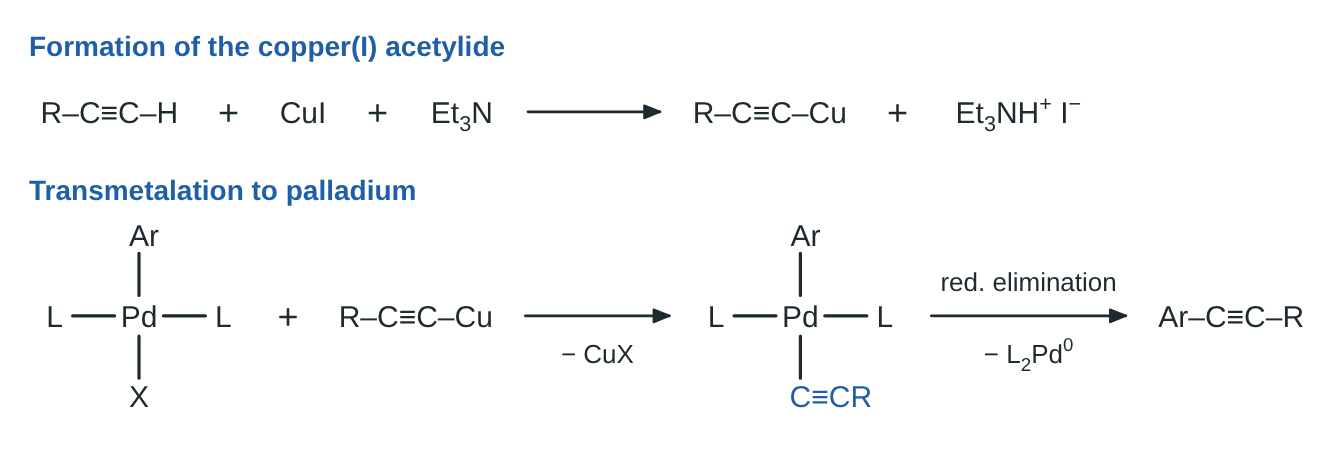
The H of a terminal alkyne is acidic (pKa ≈ 25; review alkynes), but not enough for the amine to remove it on its own. Copper(I) coordinates to the triple bond, increases its acidity and forms a copper acetylide, which is the nucleophile in the transmetalation to the arylpalladium. Palladium follows its usual cycle, and copper its own.
The reaction was published by Kenkichi Sonogashira, Yasuo Tohda and Nobue Hagihara in 1975. Copper-free variants, which avoid Glaser coupling, are also available today.