
The Heck reaction
In the Heck reaction (or Mizoroki–Heck reaction) an aryl or vinyl halide is joined to an alkene, in the presence of a palladium catalyst and a base, and the product is a substituted alkene. Unlike the other couplings, no organometallic reagent is needed: the alkene inserts into the Pd–C bond.
The reaction

The reaction works best with electron-poor alkenes (acrylates, acrylonitrile) or with styrene. The aryl group bonds to the less substituted carbon of the alkene, for steric reasons, and the product is almost always the E alkene. Palladium(II) acetate is reduced in the medium to the active palladium(0) species.
Mechanism
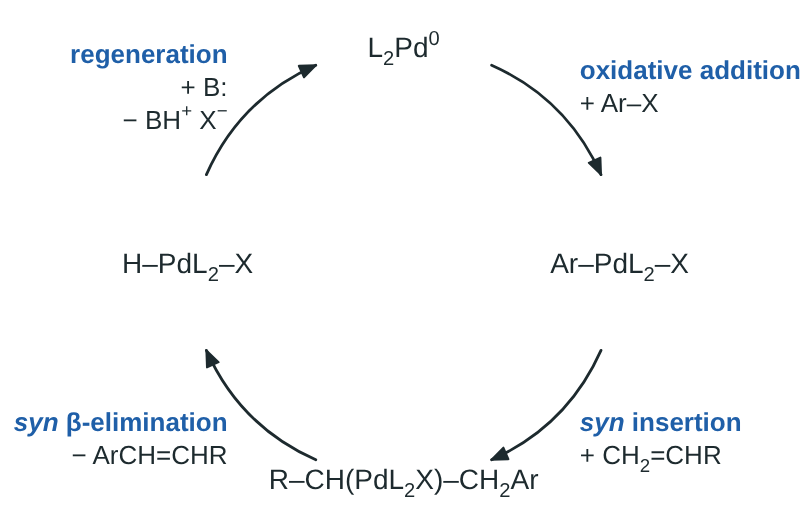
After oxidative addition, the alkene coordinates to palladium and inserts into the Pd–aryl bond: the aryl group and palladium add syn across the double bond. The resulting alkylpalladium rotates until a hydrogen on the β carbon is syn to the metal and undergoes β-hydride elimination, which regenerates the double bond, now substituted. The base neutralizes the HX of the palladium hydride and returns Pd(0) to the cycle.
The intramolecular Heck reaction is very useful for closing rings, even those containing quaternary centres, and with chiral ligands such as BINAP it can be made enantioselective.
Tsutomu Mizoroki (1971) and Richard F. Heck (1972) discovered the reaction independently. Compare its key step, β-hydride elimination, with the pyrolytic syn eliminations.