
The Suzuki coupling
The Suzuki coupling (or Suzuki–Miyaura coupling) joins an aryl or vinyl halide or triflate with a boronic acid or ester. Boron compounds are stable to air and water, of low toxicity and compatible with almost every functional group, which is why it is the most widely used coupling, both in the laboratory and in the pharmaceutical industry.
The reaction

Boronic acids are prepared by reacting an organolithium or a Grignard reagent with trimethyl borate followed by hydrolysis, or directly from the halide with bis(pinacolato)diboron and a palladium catalyst (Miyaura borylation). The more stable pinacol esters can be purified by chromatography. The reaction is often carried out in mixtures of an organic solvent and water, and the boron by-products are removed by simple washing.
The role of the base
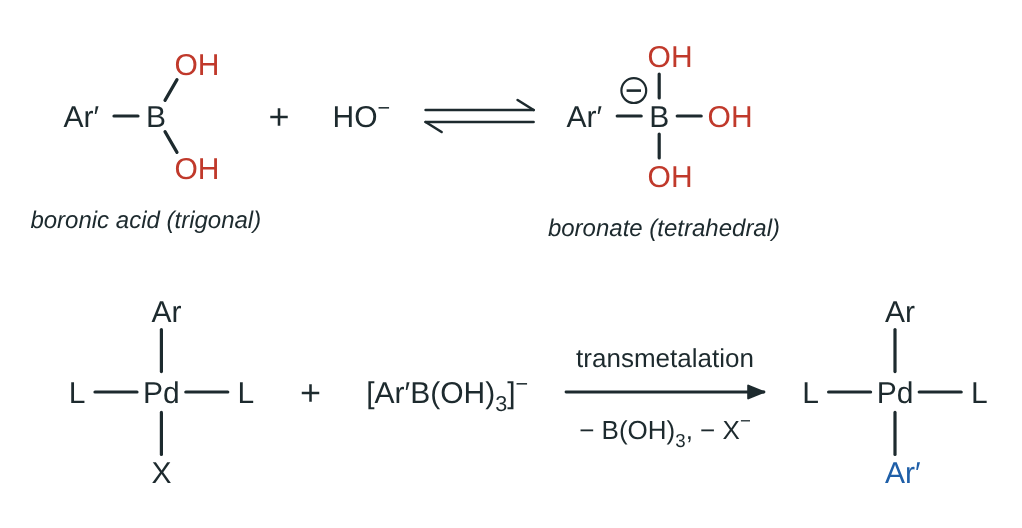
The C–B bond is not very polar, and the boronic acid, with trigonal boron and its empty p orbital, does not transfer the organic group to palladium. The base (a carbonate, a phosphate or a hydroxide) is essential: it binds to boron and forms a tetrahedral, more nucleophilic boronate, or it replaces the halide on palladium and forms a Pd–OH complex that reacts with the neutral boronic acid. In both cases the organic group passes from boron to palladium through a Pd–O–B bridge.
The coupling was described by Akira Suzuki and Norio Miyaura in 1979. With modern catalysts (Buchwald phosphines, NHCs) the cheaper aryl chlorides, and even alkyl groups, can also be coupled.