
Olefin metathesis
In olefin metathesis two alkenes exchange their alkylidene fragments: the double bonds are broken and re-formed between other pairs of carbons. It is catalysed by ruthenium and molybdenum complexes with a metal–carbon double bond (metal carbenes), and it is one of the most powerful methods for forming rings and alkenes.
The Chauvin mechanism
In 1971 Yves Chauvin and Jean-Louis Hérisson proposed that the catalyst is a metal carbene, M=CHR. The alkene adds to it in a [2+2] cycloaddition to form a metallacyclobutane, which opens through the other pair of bonds and gives a new alkene and a new metal carbene, which continues the cycle.

All the steps are reversible, so metathesis is an equilibrium. To make it useful in synthesis it must be driven, usually because one of the products is ethylene, a gas that escapes from the medium.
The catalysts
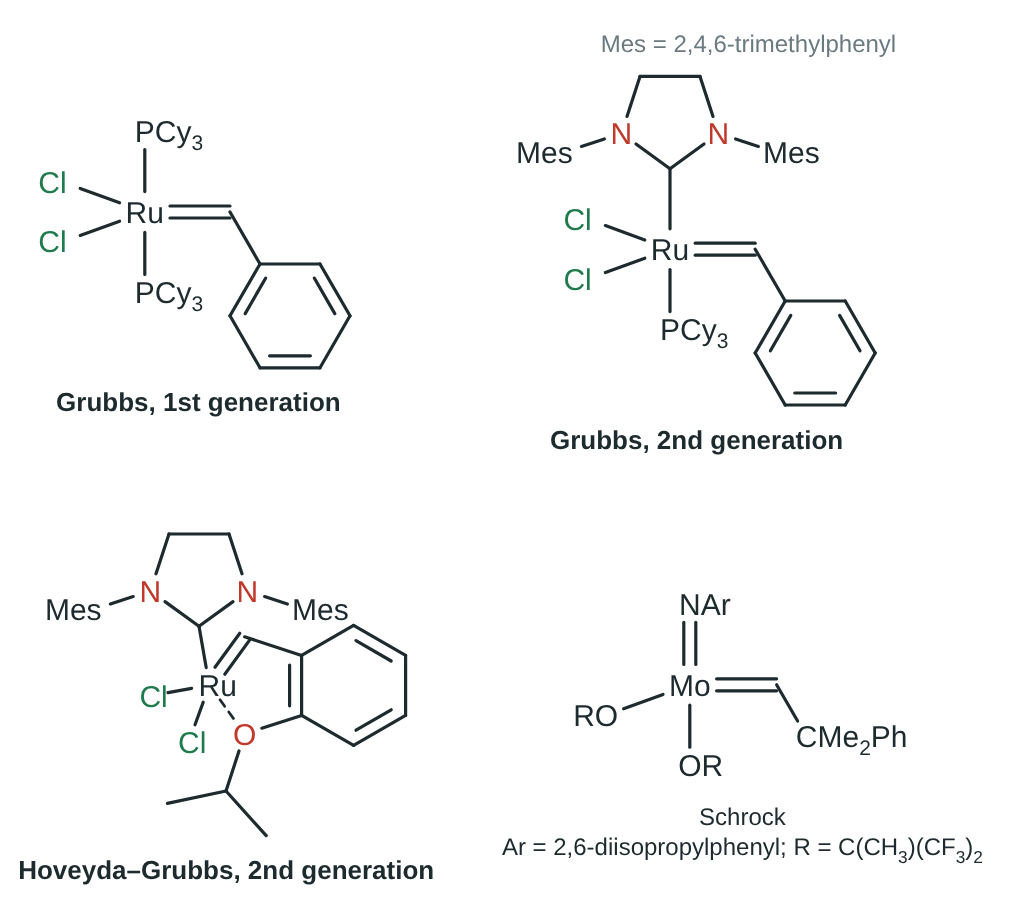
The first catalysts were ill-defined mixtures of tungsten or molybdenum halides with alkylaluminium compounds, still used in the petrochemical industry. The Schrock catalysts (1990), molybdenum alkylidenes, are very active but sensitive to air, water and many functional groups. The ruthenium catalysts of Grubbs are less active but tolerate water, alcohols, acids and aldehydes and can be handled in air; the second generation, with an N-heterocyclic carbene in place of one of the phosphines, and the Hoveyda–Grubbs catalysts, with a chelating ether, are the most widely used.
Types of metathesis
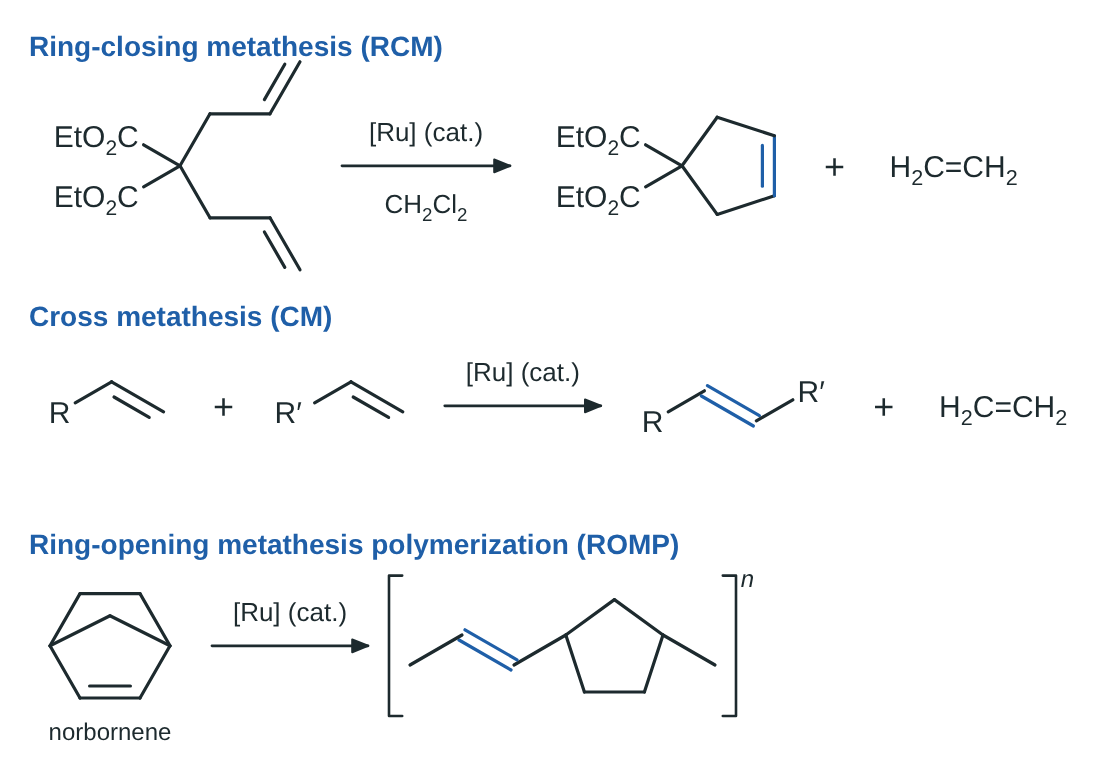
- Ring-closing metathesis (RCM) converts a diene into a cycloalkene and ethylene. It is used for five- to seven-membered rings and, at high dilution, for macrocycles.
- Cross metathesis (CM) joins two different alkenes. To avoid the statistical mixture, an alkene that dimerizes easily is combined with one that does so poorly, such as an acrylate.
- Ring-opening metathesis polymerization (ROMP) converts strained cycloalkenes, such as norbornene, into polymers with double bonds in the chain; the driving force is the release of ring strain. Compare it with alkene polymerization.
Chauvin, Grubbs and Schrock received the 2005 Nobel Prize in Chemistry for the development of metathesis in organic synthesis. Compare metathesis with the other ways of making double bonds in topic 8.