
Lewis Structures
Lewis structures are simple, reasonable representations of compounds and ions that allow us to keep an exact count of electrons and are the basis for predicting relative stabilities.


Lewis Structures
- Select a central atom. Never H. In general, the least electronegative one.
- Count the valence electrons.
- Make bonds between the central atom and the peripheral ones.
- The remaining electrons are placed as lone pairs to complete the octets.
Ammonia, NH3
- N is central
- Valence e− = 5 + 3·1 = 8 (4 pairs)
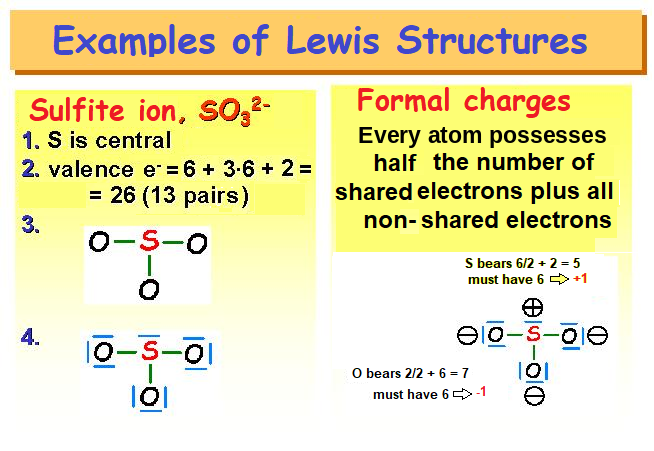


Summary of Lewis Rules
- Count the valence electrons and take into account positive or negative charges if dealing with a molecular ion.
- Number of electron pairs: (valence electrons) / 2.
- Central atom: the least electronegative (NEVER hydrogen).
- Bond the atoms with bonding electron pairs (BP).
- Complete the octets placing electron lone pairs on the correct atoms (LP).
- Write multiple bonds if there are atoms with incomplete octets.
- Assign formal charges: FC = Z − BP − 2·LP
- Select as correct the structures with the least possible charge separation (remember that ONLY atoms from the 3rd period or higher are able to sustain an environment of more than four electron pairs).
- Be aware of possible equivalent structures by RESONANCE.