Ethylcyclohexane
An ethyl group in cyclohexane has the same conformational energy as a methyl group. Why, if an ethyl group is clearly larger than a methyl group? Let's have a look at the 3D structures of the axial chair forms of the two molecules.
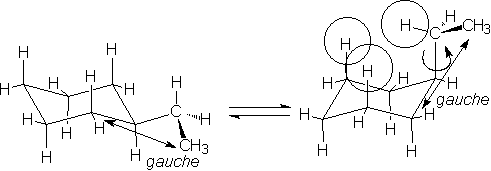
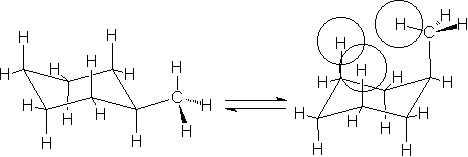
In ethylcyclohexane, the C-C bond between carbon 1 of the ring and the first carbon of the ethyl group can rotate (curved arrow) so that the methyl group of the ethyl points away from the ring. Therefore, the interactions of the ring's axial hydrogens at positions 3 and 5 are identical in methyl- or ethylcyclohexane -circles-. That's why the conformational energies of these two molecules are the same.