Isopropylcyclohexane
The isopropyl group bears a conformational energy slightly higher than those of methyl and ethyl groups. This is not surprising, since an isopropyl group is undoubtedly larger than the other two groups. However, the reason for the increase in conformational energy is not that simple. Let's look at the 3D structure of the two conformers in equilibrium.
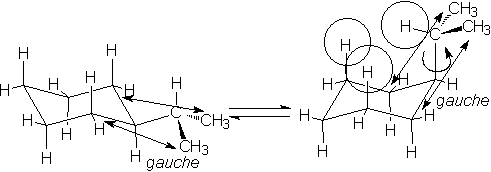
Isopropylcyclohexane
Isopropylcyclohexane
The single C-C bond between ring's carbon 1 and isopropyl's central carbon can rotate -curved arrow- in such a way that isopropyl's two methyl groups lie outside the ring. Therefore, the interactions of ring's axial hydrogens at positions 3 and 5 are the same as in methyl- or ethylcyclohexane. Why is thus isopropyl's conformational energy higher than in the latter molecules? Let's recall that the conformational energy of a given group is the free energy change between the chairs in equilibrium. Yet, the free energy has two terms: one enthalpic and one entropic. The enthalpic term is the same, regardless whether the cyclohexane bears either an isopropyl, ethyl or methyl groups because the interactions are the very same, as it was graphically revealed. However, the entropic term is very different in isopropylcyclohexane. Entropy means order/disorder or more or less degrees of freedom. In ethylcyclohexane, ethyl's methyl group had two possible arrangements pointing outwards the ring by the 120º rotation of the C-C bond. That's not possible in isopropylcyclohexane. The C-C cannot be rotated -curved arrow- unless we place an isopropyl's methyl group inside the ring. This fact severely constricts the freedom of movement of isopropyl thus increasing its free energy as compared to ethyl and methyl groups.