
SolutionsRelative Stability
Which of the following cycloalkanes has the highest heat of combustion per CH2 group? And the second?
A) cyclooctane
B) cyclopropane
C) cyclohexane
D) cyclobutane
E) cycloheptane
F) cyclopentane
B) cyclopropane (first)
D) cyclobutane (second).
Which of the following lists correctly arranges the cycloalkanes from lowest to highest ring strain?
A) cyclopropane < cyclobutane < cyclohexane < cyclopentane
B) cyclohexane < cyclopentane < cyclobutane < cyclopropane
C) cyclohexane < cyclobutane < cyclopentane < cyclopropane
D) cyclopentane < cyclopropane < cyclobutane < cyclohexane
E) cyclopropane < cyclopentane < cyclobutane < cyclohexane
B) cyclohexane < cyclopentane < cyclobutane < cyclopropane
Calculate the heats of combustion of cycloalkanes up to 14 members and, from the experimental heats in the table, calculate the corresponding heats of formation. Give a brief explanation of the obtained values.
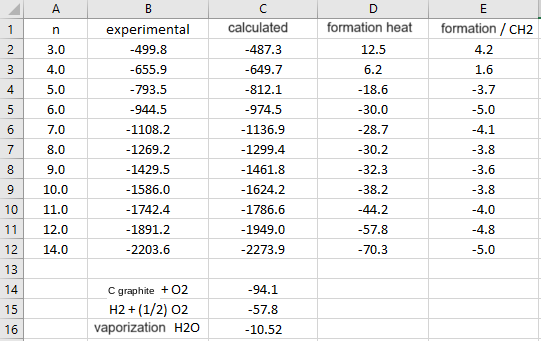
Cyclopropane and cyclobutane are less stable structures than their starting atoms because their heats of formation are positive.
These cycloalkanes, especially cyclopropane, have bond tension because their internal angles (60º and 90º) are much smaller than the "natural" tetrahedral angle (109.5º) of an sp3 carbon.
These cycloalkanes, especially cyclopropane, have eclipsing tension between the hydrogens of adjacent CH2 groups.
Cyclohexane is the smallest cycloalkane with the lowest heat of formation per CH2 group and, therefore, it is the most stable.
Cyclohexane in its chair conformation has C-C-C bond angles (approx. 108º) very similar to the "natural" tetrahedral and all CH2 groups are perfectly staggered.
The internal angle of a cyclopentane is almost tetrahedral but, unlike cyclohexane, it cannot adopt a "chair" shape and the eclipsing strain remains.
The ring has to be as large as 14 carbons to achieve a stable situation like that of cyclohexane. The cycloalkanes between cyclohexane and cyclotetradecane always have some eclipsing tension which makes the heats of formation per CH2 group not so negative.