
Stability of radicals
Free radicals - formed by homolytic cleavage of a C-H bond in alkanes - are reactive intermediates whose (in)stability depends on their tertiary (less unstable), secondary or primary structure:
The more substituted a radical, the less unstable it is.
Look at the following experimental data. What can you deduce from them? A whole lot of things...

- One obtains mixtures of compounds
- The various positions - two kinds of primary, one secondary and another tertiary - react differently
- The reaction con Br2 looks much more selective
- The tertiary position is the most reactive one, followed by the secondary position. The least reactive is the primary one.
Thanks to these data it was experimentally found that the strength of C-H bonds is not always the same and depends on the structure.

Experimental results allow us to deduce that the more substituted the radical centre, the less unstable the radical. Yet, is there a theoretical explanation to this behavior?
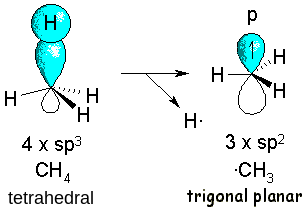
Very sophisticated experimental techniques show that the methyl radical is trigonal planar. Hence, homolytic cleavage of a C-H bond in methane must involve a change in hybridization, from sp3 to sp2, the unpaired electron residing in the leftover p orbital.
The central carbon of the ·CH3 radical is electron-deficient because its octet is incomplete. End of story in the methyl radical. However, if the radical is more complex, electron density can be drawn in from neighbouring atoms, reducing the inherent instability of the radical center.

The neighboring sigma bonds to the radical p orbital can give rise to a certain degree of distorted, lateral overlapping - reminiscent of a pi bond but much less effective. The electron deficiency at the radical center can thus be mitigated to a small extent. The more sigma bonds surrounding the radical center, the larger its stabilization, although always small. This simple rationale allows us to understand why a tertiary radical is the least unstable of them all.