
SolutionsHydroboration
1. Three ways to hydrate
Predict the result of the following reactions:

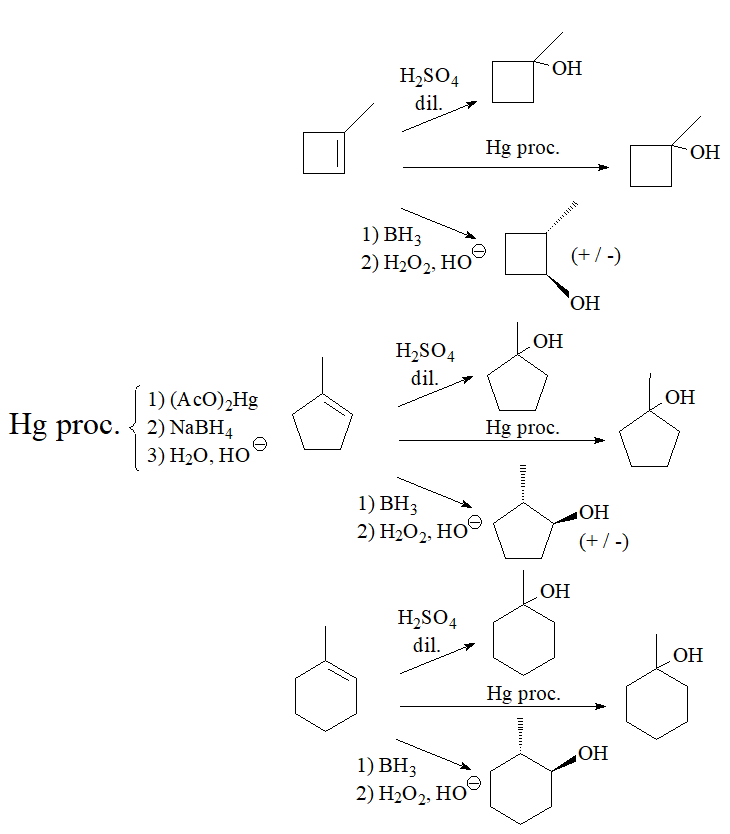
Hydroboration is a syn, anti-Markovnikov addition: boron bonds to the less substituted carbon and H to the other from the same face; OH then replaces boron with retention, so OH and the methyl group end up trans.
2. Design the synthesis
How would you prepare 3-methylbutan-1-ol from an alkene?
By hydroboration-oxidation of 3-methylbut-1-ene: BH3 in THF then H2O2, HO−. The OH goes onto the terminal carbon.
3. Why no rearrangements?
3,3-Dimethylbut-1-ene gives 3,3-dimethylbutan-1-ol by hydroboration-oxidation, with no rearrangement products. Why?
Because hydroboration is concerted: boron and hydrogen bond at the same time through a four-centre transition state, and no carbocation that could rearrange is ever formed.