
Benzene's Puzzle
Faraday first isolated benzene in 1825 from illuminating gas and obtained "CH" as its empirical formula. In 1834 Mitscherlich determined its molecular formula as C6H6, which was difficult to explain at the time because it seemed to violate the tetravalency of carbon.



Michael Faraday FRS (22 September 1791 – 25 August 1867) was an English scientist who contributed to the study of electromagnetism and electrochemistry. His main discoveries include the principles underlying electromagnetic induction, diamagnetism and electrolysis.
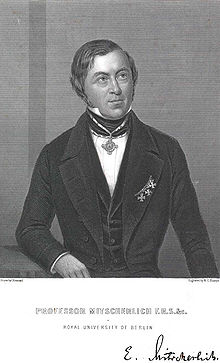
Eilhard Mitscherlich (7 January 1794 – 28 August 1863) was a German chemist, who is perhaps best remembered today for his discovery of the phenomenon of isomorphism (crystallography) in 1819.
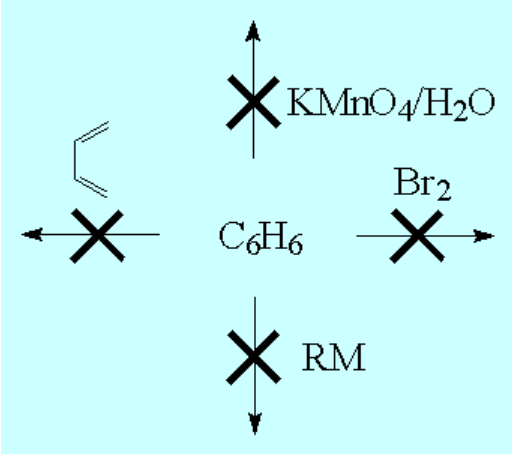
Benzene is a highly unsaturated hydrocarbon, very special and very stable, that does not undergo the usual reactions of alkenes or alkynes. That's puzzling! Why is that?
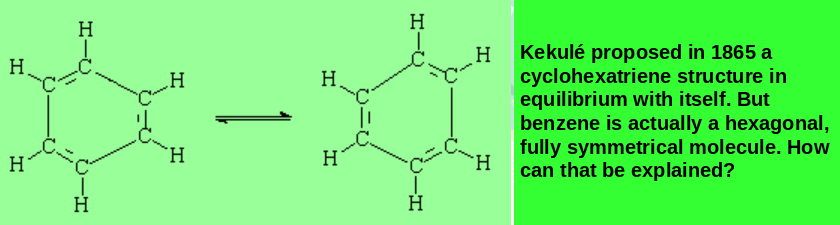
The heat released when benzene is hydrogenated is much lower than that anticipated if the three double C=C bonds behaved as "normal" alkenes. This experimental fact indicates that benzene is much more stable than expected.
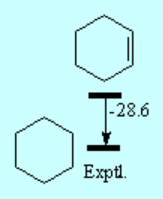
When cyclohexene is hydrogenated, 28.6 kcal/mol are released.
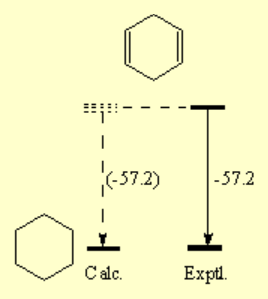
When 1,4-cyclohexadiene (isolated C=C double bonds) is hydrogenated, exactly the expected amount of heat is released, 2 × 28.6 = 57.2 kcal/mol. The isolated double bonds behave as two ordinary double bonds and have no additional stabilization.
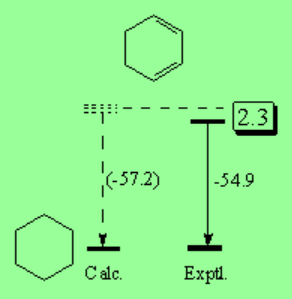
When conjugated 1,3-cyclohexadiene is hydrogenated, 54.9 kcal/mol are released, 2.3 kcal/mol less than expected. This means that the conjugated double bonds have a special stabilization and do not behave like isolated ones.
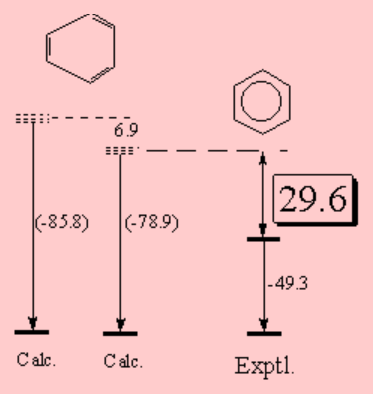
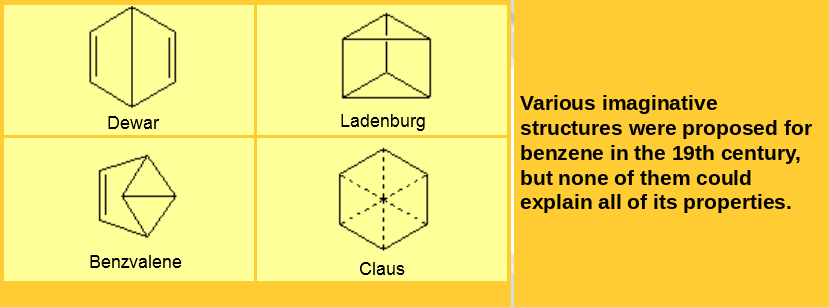
If benzene were a simple set of three isolated C=C double bonds in a six-membered ring, 3 × 28.6 = 85.8 kcal/mol would be released on hydrogenation. Subtracting 2.3 kcal/mol for each of the three conjugations, we would arrive at 85.8 − 3 × 2.3 = 78.9 kcal/mol. However, only 49.3 kcal/mol are released: benzene is nearly 30 kcal/mol more stable than expected for the simple cyclohexatriene proposed by Kekulé. Where does that stabilization come from?