
Nucleophilic Substitution
In principle, one can replace a good leaving group with ammonia or amines leading to a more complex amine or ammonium salt. However, such reactions do not proceed in good yields except in exceptional cases.
 ▶ Watch the video on YouTube
In general, nucleophilic substitution is not a useful method for preparing amines.


Direct SN with ammonia does not work well because the primary amine is more nucleophilic than ammonia and competes with it. Worse still, the secondary and tertiary amines formed are even more nucleophilic, and the competition becomes even more complicated. The reaction only works well when it is used to obtain the final ammonium salt.

Even with a large excess of ammonia, the yield of SN reactions is low and complex mixtures of amines that are hard to separate are obtained.
Important alternative: carry out the substitution with a precursor of the amine group that can react only once. The amino group remains latent until it is "revealed".
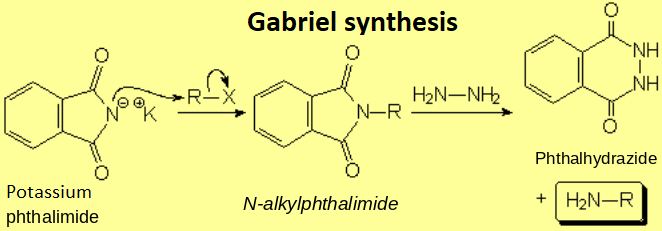
Siegmund Gabriel (7 November 1851 – 22 March 1924) was a German chemist who had the idea of using phthalimide as a precursor function of an amine. The amine was "revealed" by treating the alkylphthalimide, the product of nucleophilic substitution with an R–X, with hydrazine (H2N–NH2).

How can phthalimide be obtained?
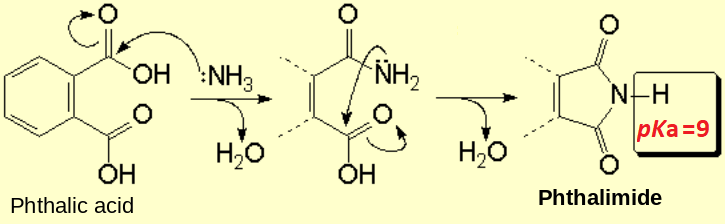
By heating phthalic acid with ammonia: an amide forms first, with loss of a water molecule, and then the amide nitrogen attacks the second carboxyl group and closes the ring, with loss of another water molecule.
The N–H of phthalimide is fairly acidic (pKa = 9) because the negative charge of the anion is delocalized over the two carbonyl groups; that is why KOH easily deprotonates it to give potassium phthalimide.
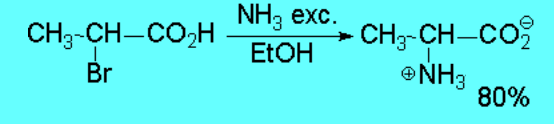
In some special cases, such as α-halocarboxylic compounds, treatment with ammonia gives excellent results for preparing α-amino acids.
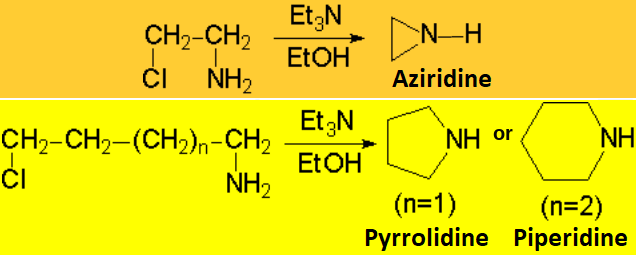
The "intramolecular" attack of an NH2 or NHR group on a carbon bearing a good leaving group gives cyclic compounds in reasonable yields.
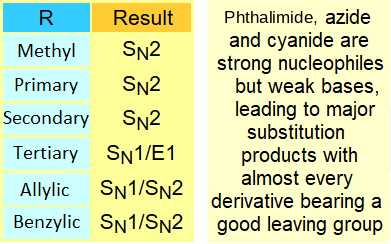
There are other functions that carry the amine function in latent form: azide and cyanide.
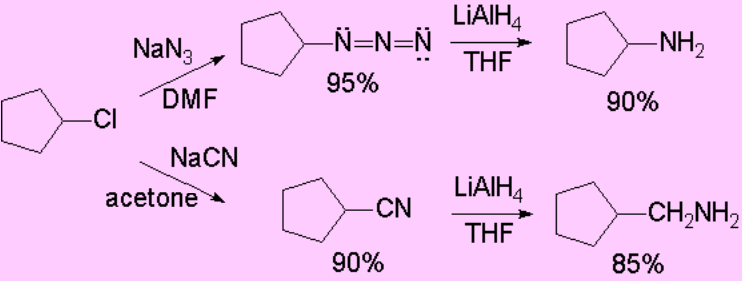
Once the substitution has taken place, reduction of the azide or nitrile functions gives the amine; in the case of cyanide, with one more carbon atom.