
SolutionsAcetal Formation
1. An alkyne with a ketone
How would you plan the synthesis of the alkyne in the figure (5-heptyn-2-one)?

Hint: use the protection and deprotection of the C=O group.
Retrosynthetically, the strategic bond to be formed is the one marked with the red arrow, taking advantage of the relative acidity of propyne, which, once deprotonated, could be alkylated with the appropriate alkyl halide:

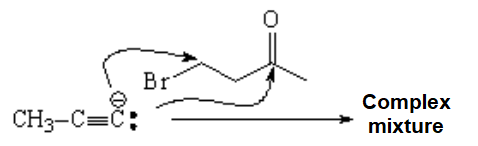
But this plan has a serious drawback. Can you tell what it is? The carbonyl is a strong electrophilic center that competes with the halogenated carbon. The reaction will give an inconvenient mixture of products and be very inefficient.
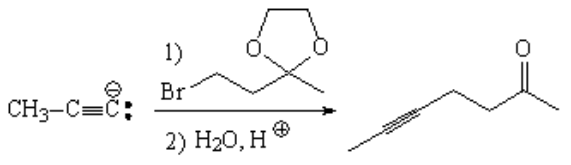
The solution is to protect the carbonyl group by turning it into an acetal before the nucleophilic substitution of the halogen by the alkynide. At the end, the carbonyl is recovered by acid hydrolysis.
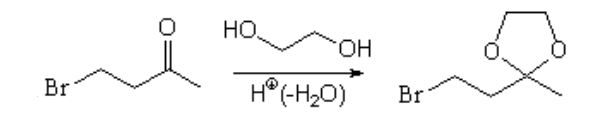
But how is the acetal made? Ethylene glycol is very commonly used as a protecting group for aldehydes and ketones. It carries in itself the "two alcohol functions" needed to form a very stable cyclic acetal.
2. Hydrolysis of acetals
What happens to the following acetals when they are treated with a large excess of water in basic medium? And in acid medium?

In basic medium nothing happens: acetals are stable towards bases, like ethers (which is why they are used as protecting groups). In acid they are hydrolyzed:
- 4-Ethoxybenzaldehyde and two molecules of ethanol (the ethoxy group on the ring is an ether and is not hydrolyzed).
- Cyclohexanone and ethylene glycol.
- Methanol and 4-hydroxypentanal, which is in equilibrium with its cyclic hemiacetal (see the hemiacetal exercise). The carbon bearing the methyl group keeps its configuration.
3. Grignard and a protected aldehyde
How would you synthesize 5-hydroxy-5-phenylpentanal using Grignard or organolithium reagents?
The aldehyde cannot be free in the molecule of the Grignard reagent, because it would react with it. It is protected as an acetal: 4-bromobutanal is treated with ethylene glycol and acid to give 2-(3-bromopropyl)-1,3-dioxolane, which forms the Grignard reagent with magnesium. This adds to benzaldehyde; the workup with aqueous acid protonates the alkoxide and also hydrolyzes the acetal.
The product, a δ-hydroxyaldehyde, is in equilibrium with its six-membered cyclic hemiacetal (6-phenyltetrahydropyran-2-ol).
4. Protecting alcohols with DHP
DHP or dihydropyran (oxacyclohex-2-ene) reacts with alcohols in acid to give an acetal. This is a method for protecting alcohols. Can you propose mechanisms for the formation of the acetal (protection of the alcohol) and for its cleavage in aqueous acid (deprotection of the alcohol)?
Protection. The acid protonates the double bond of the enol ether at C3, so that an oxocarbenium ion forms at C2, stabilized by the lone pair of the ring oxygen. The alcohol attacks that carbon and, after losing a proton, gives the tetrahydropyranyl (THP) ether, an acetal.
Deprotection. In aqueous acid the oxygen of the OR group is protonated and the alcohol leaves, regenerating the oxocarbenium ion. Water attacks it to give the hemiacetal (2-hydroxytetrahydropyran), in equilibrium with 5-hydroxypentanal. The alcohol is released.