The COSY experiment
COSY (COrrelation SpectroscopY) is the simplest and most widely used two-dimensional experiment. Both axes carry the 1H spectrum, and each cross peak links two hydrogens that are coupled to each other. It is used to rebuild the chains of neighbouring hydrogens in a molecule.
What a COSY shows
Couplings between hydrogens make 1H spectra much more complicated. When many signals overlap, it is impossible to tell which multiplet couples to which by comparing constants. COSY solves this at a glance: if two hydrogens are coupled, a cross peak appears where their chemical shifts intersect.
Let us look at the simplest case, 1-chloropropane, Cl–CH2–CH2–CH3. Its 1H spectrum has three signals: a (3.52 ppm), b (1.80 ppm) and c (1.04 ppm).
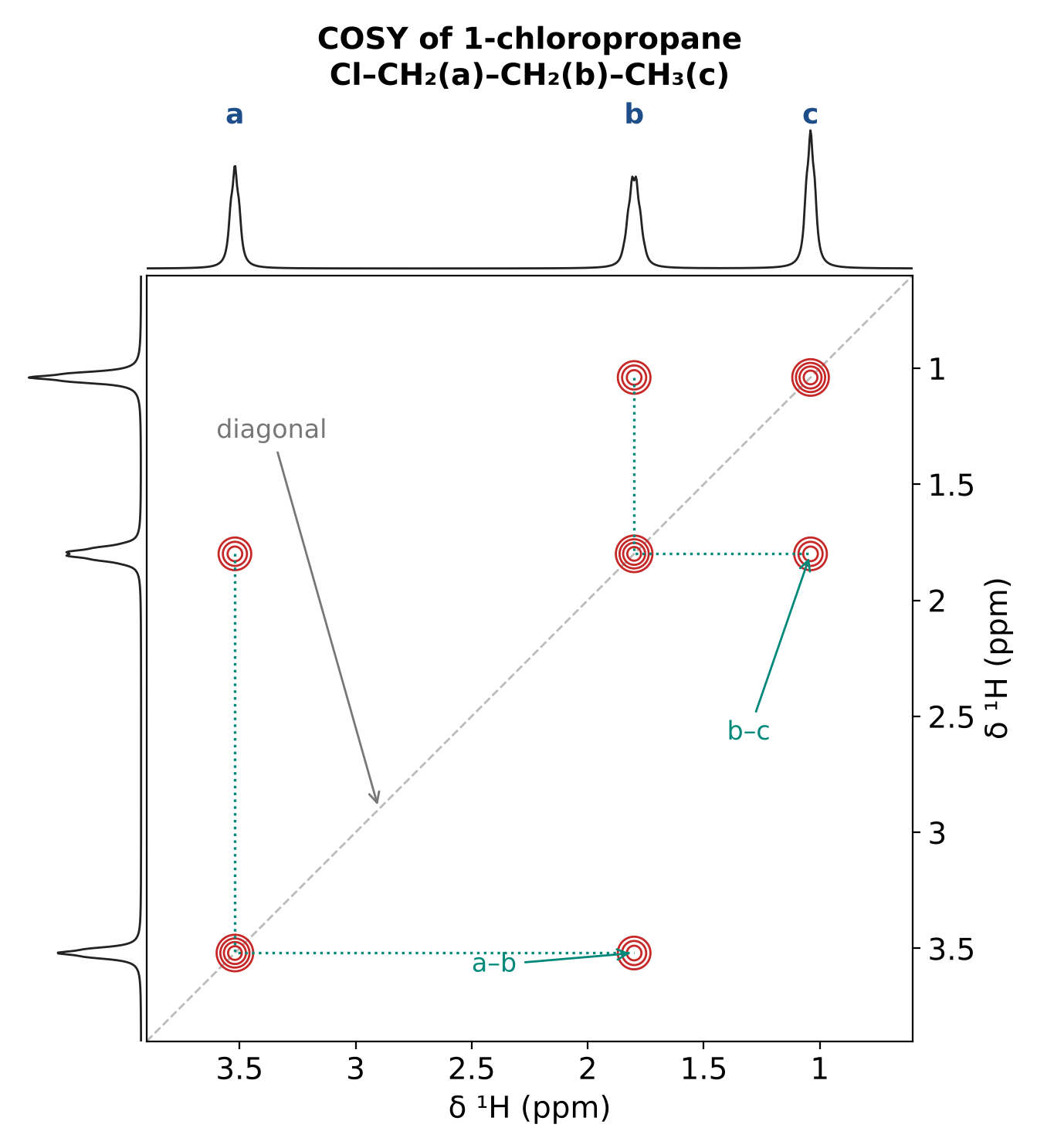
- The three signals appear on the diagonal (dashed line).
- There is a cross peak at (1.80, 3.52) and its mirror image at (3.52, 1.80): a and b are coupled.
- There is another pair at (1.04, 1.80) and (1.80, 1.04): b and c are coupled.
- There is no peak between a and c: their hydrogens are four bonds apart and do not couple appreciably.
To read a cross peak, draw lines from it, one vertical and one horizontal, to the diagonal. The two diagonal signals you reach are the coupled ones. The lines form a square with two corners on the diagonal; that is why many figures mark correlations with squares or "parallelograms".
Which couplings are seen
- Mainly vicinal (3J, H–C–C–H) and geminal (2J, H–C–H) couplings between non-equivalent hydrogens, such as those of a diastereotopic CH2.
- Sometimes, with lower intensity, four-bond couplings (4J): allylic, "W" couplings or between meta aromatic hydrogens.
- Equivalent hydrogens give no cross peak with each other, because their coupling does not show in the spectrum.
- The intensity depends on the constant: a very small coupling (less than 1 Hz) may not be seen, and one of 0 Hz, as sometimes happens with a dihedral angle close to 90°, does not appear even though the hydrogens are neighbours.
How it is used
The strategy is to start from an easily assigned signal, such as a methyl, a CH bonded to a heteroatom or an olefinic hydrogen, and "hop" from cross peak to cross peak. Each hop leads to a neighbouring hydrogen, and so the chain is traced. When the chain is interrupted, by a quaternary carbon, a heteroatom or a carbonyl, COSY cannot go further: the HMBC is needed.
Each pair of symmetric cross peaks in a COSY links two coupled hydrogens. Following these links rebuilds the network of neighbouring hydrogens in the molecule.
In the next section we interpret a real COSY step by step, that of ethyl crotonate.