Interlocked molecules: catenanes and rotaxanes
Two rings can be held together without any bond between them, like the links of a chain. Interlocked molecules, catenanes and rotaxanes, are held together by a mechanical bond: to separate them, a covalent bond has to be broken.
Catenanes and rotaxanes

- A catenane (from the Latin catena, chain) is made of two or more interlocked rings.
- A rotaxane (from the Latin rota, wheel, and axis, axle) is a ring threaded on a linear molecule whose ends carry bulky groups, the stoppers, that prevent the ring from slipping off.
The number in brackets gives the number of components: a [2]catenane has two rings and a [3]rotaxane, two rings on the same axle. If the axle has no stoppers, the ring can slip off: it is a pseudorotaxane, a simple host–guest complex in equilibrium with its components.
A catenane and its separate rings have the same formula and the same bonds, but they are not the same molecule: they are topological isomers. One cannot be turned into the other without breaking a bond, just as two links cannot be separated without opening one.
How they are made
Threading a ring by chance is very unlikely: when a macrocycle is closed in the presence of another, it almost never ends up inside it. Efficient syntheses use a template that puts the pieces in the right position before the ring is closed:
- a metal ion (Cu+) coordinating two crossed phenanthroline ligands (Jean-Pierre Sauvage, 1983);
- π interactions between electron-rich and electron-poor rings and hydrogen bonds (J. Fraser Stoddart);
- the active template: the metal sits in the macrocycle and catalyses the reaction that builds the axle through it, for example a copper-catalysed alkyne coupling.
Sauvage, Stoddart and Ben Feringa shared the 2016 Nobel Prize in Chemistry for the design and synthesis of molecular machines, many of them catenanes and rotaxanes in which a ring rotates or shuttles along the axle in response to a chemical, electrical or light stimulus.
A ring that protects another
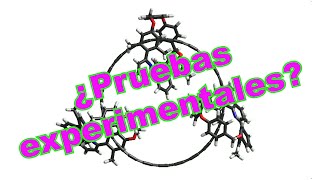
The mechanical bond can also protect. Cyclo[48]carbon, a ring of 48 sp carbons too reactive to exist on its own, has been studied in solution as a [4]catenane, threaded through three macrocycles that stop two cyclocarbons from meeting (see Cyclo[48]carbon).