
Cyclo[48]carbon: an impossible synthesis
A ring of 48 carbon atoms joined by alternating single and triple bonds is one of the most sought-after, and most unstable, molecular forms of carbon. In 2025 it could finally be studied in solution at room temperature thanks to a simple idea: threading it through three other rings that protect it. It is a retrosynthesis example in which the protection is not chemical but mechanical.
The target molecule
Cyclocarbons are rings made only of sp carbons, with alternating single and triple bonds (C≡C–C≡C…). Like diamond, graphite, fullerenes and graphene, they are an allotropic form of carbon. Cyclo[48]carbon (C48) has 24 triple and 24 single bonds and a diameter of about 2 nm.
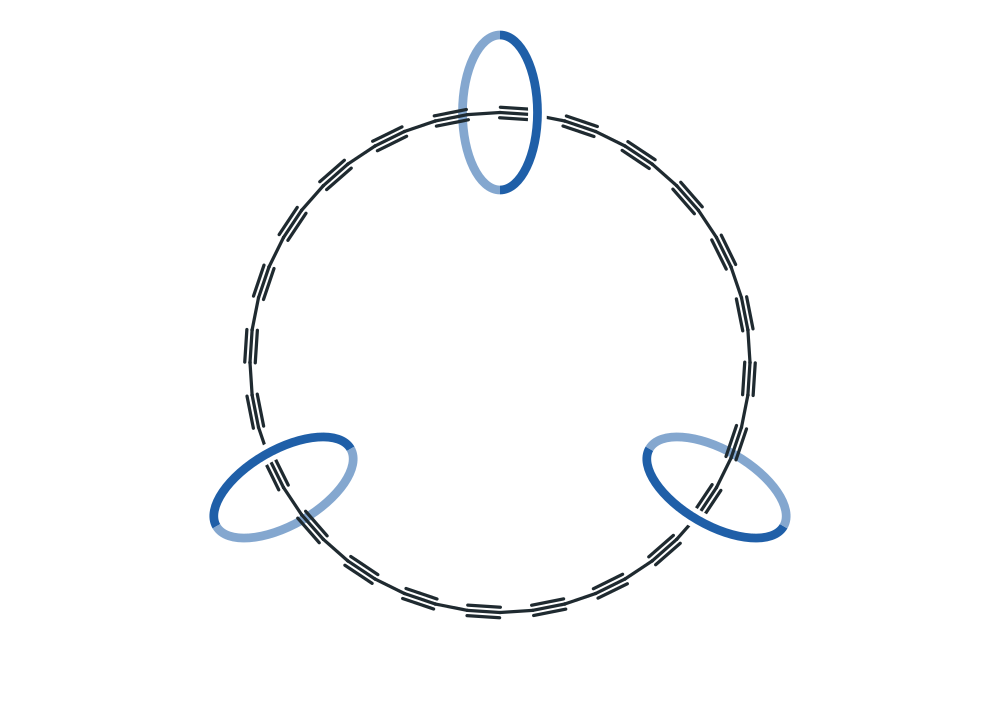
Until recently, these rings had only been observed in the gas phase or at very low temperatures (4 to 10 K), for example on a salt surface in a scanning tunnelling microscope. The reason is their huge reactivity: the triple bonds of one ring attack those of another, or of the same ring, and the molecule is destroyed as soon as two of them meet.

The retrosynthetic analysis and the failure
The natural disconnection of a chain of triple bonds is the C(sp)–C(sp) single bond: its synthetic equivalent is the copper-catalysed oxidative coupling of terminal alkynes (Glaser coupling), which joins two –C≡C–H fragments into –C≡C–C≡C–. On paper, closing the ring this way is enough. In practice, the free cyclocarbon does not survive: even if it formed, it would react with itself before it could be isolated. A «direct» synthesis is therefore bound to fail, as the video explains.

A retrosynthesis does not end when the bonds that can be made have been found: one must also ask whether the product can exist under the reaction conditions.
The solution: threading the needle
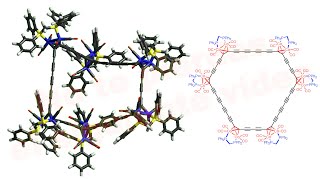
Harry Anderson's group in Oxford applied a very particular protection strategy: instead of attaching a protecting group through a covalent bond, they surrounded the 48-carbon ring with three threaded macrocycles. The linear fragments of the ring are first threaded through the macrocycles (at that stage they are rotaxanes), and closing the ring traps them for ever: the product is a [4]catenane, four mechanically interlocked rings.
The macrocycles act as «bumpers»: they prevent two cyclocarbons from coming close enough to react. They form no bond with the ring, and yet they protect it.

The proof
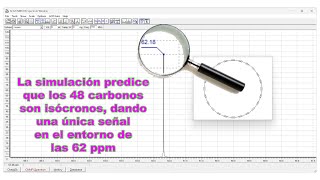
The cyclo[48]carbon catenane is stable in solution at 20 °C, which made it possible to characterise it with the usual techniques: mass spectrometry confirms its formula and NMR shows the sp carbons and the symmetry of the ring (see the course Organic structure determination).
It is the first new molecular form of carbon that can be handled under normal laboratory conditions since the fullerenes, which were prepared in bulk in 1990.
Reference: Y. Gao, P. Gupta, I. Rončević, C. Mycroft, P. J. Gates, A. W. Parker and H. L. Anderson, «Solution-phase stabilization of a cyclocarbon by catenane formation», Science 2025, 389, 708-710.