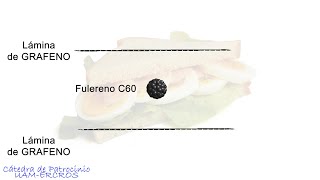
Fullerenes, nanotubes and graphene
Benzene is a hexagon of carbons with six delocalized π electrons. What happens if a huge number of hexagons are joined? You get a sheet one atom thick, graphene. And if twelve pentagons are inserted, the sheet curves and closes into a sphere: a fullerene.
The forms of carbon
Pure carbon exists in several forms (allotropes) that differ in the hybridization of their atoms and in how they are joined:
- Diamond: sp3 carbons joined in a three-dimensional network of tetrahedra, like a chair cyclohexane repeated without end.
- Graphite: sheets of sp2 carbons in hexagons, stacked and held together by weak forces. A single sheet is graphene.
- Fullerenes and nanotubes: sheets of sp2 carbons curved and closed into spheres or tubes.
- Cyclocarbons: rings of sp carbons with alternating single and triple bonds, very reactive (see Cyclo[48]carbon, in Advanced Organic Chemistry).
Graphene: an endless aromatic hydrocarbon
Naphthalene, anthracene and the other polycyclic aromatic hydrocarbons are fragments of a sheet of hexagons. If the sheet grows without limit, the edge hydrogens no longer matter and graphene is left: each sp2 carbon contributes one p orbital and one electron to a π system delocalized over the whole sheet. That is why graphene conducts electricity in its plane and is transparent, impermeable to gases and, for its thickness, extraordinarily strong. Andre Geim and Konstantin Novoselov isolated it in 2004 by peeling layers off graphite with adhesive tape, and received the 2010 Nobel Prize in Physics.
The fullerene C60
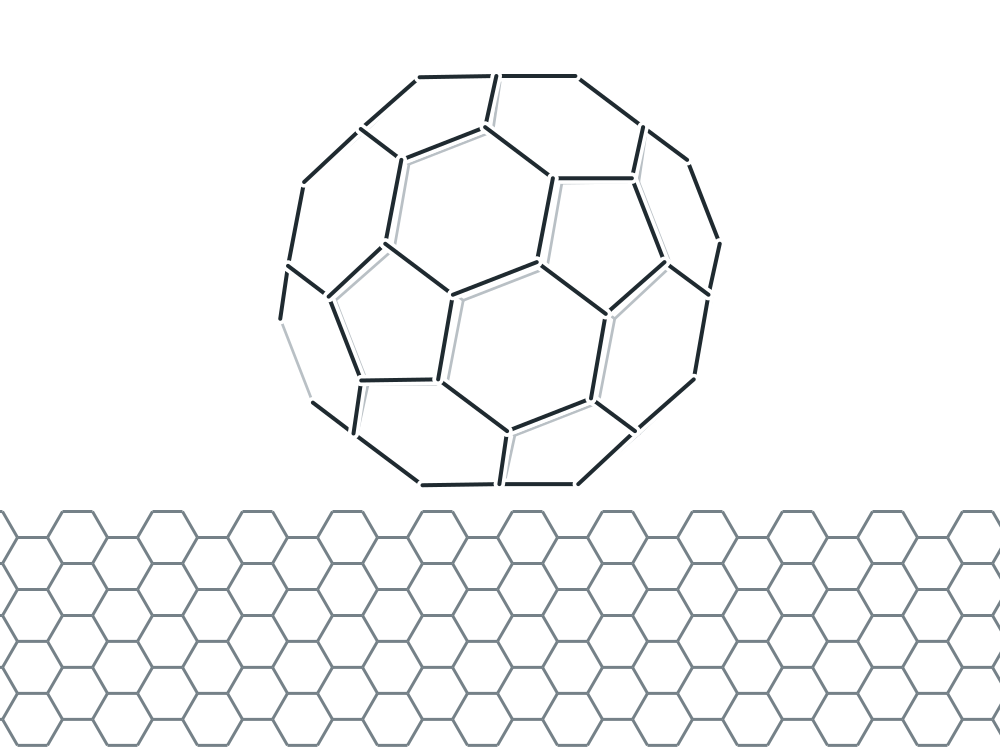
In 1985, Harold Kroto, Robert Curl and Richard Smalley detected in laser-vaporized graphite a very abundant species with 60 carbons, to which they gave the shape of a football: 12 pentagons and 20 hexagons, with all the carbons equivalent. They called it buckminsterfullerene after the architect Richard Buckminster Fuller, famous for his geodesic domes, and shared the 1996 Nobel Prize in Chemistry. In 1990, Wolfgang Krätschmer and Donald Huffman prepared it in bulk with an electric arc between graphite electrodes, and in 1991 Sumio Iijima described carbon nanotubes.
C60 is not a perfect aromatic sphere. Its bonds have two lengths: those between two hexagons (6-6 bonds, about 1.40 Å) have double-bond character, and those between a hexagon and a pentagon (5-6 bonds, about 1.45 Å), single-bond character. In addition, the carbons are pyramidalized by the curvature. That is why C60 behaves like an electron-poor alkene: it undergoes addition reactions at the 6-6 bonds (of nucleophiles, Diels–Alder cycloadditions, cyclopropanations) rather than the substitutions typical of benzene.
The more hexagons a flat system has, the more it resembles graphene; the curvature imposed by the pentagons reduces aromaticity and increases reactivity.