
Epothilone
Epothilones are 16-membered macrolides produced by the myxobacterium Sorangium cellulosum. Like taxol, they stabilize microtubules and halt cell division, but they also act on tumour cells resistant to taxol. Their retrosynthesis is much more complicated than that of the previous examples.
Gerhard Höfle and Hans Reichenbach, in Braunschweig, isolated the epothilones and published their structure in 1996. Epothilone A has seven stereocentres, a cis epoxide, a lactone, a ketone, two alcohols and a side chain with a thiazole. The groups of Samuel Danishefsky (1996), K. C. Nicolaou and Dieter Schinzer (1997) completed the first total syntheses.
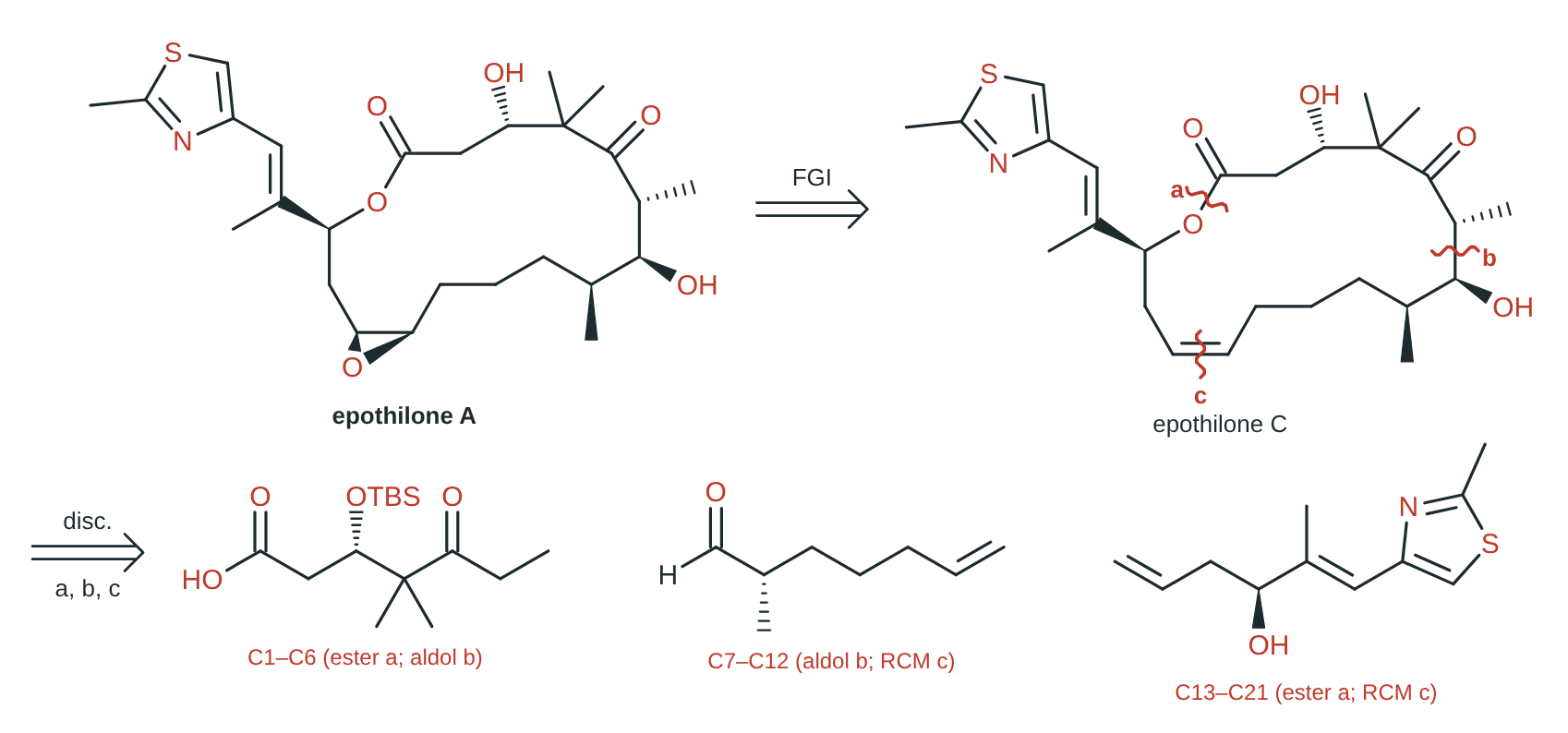
Nicolaou's analysis can be summarized in three steps. First, an FGI: the epoxide comes from epoxidation of the Z alkene of epothilone C, also a natural product. Second, the lactone is disconnected into a hydroxy acid. Third, three key disconnections give three fragments of similar size, joined by an aldol reaction (C6–C7, which sets two stereocentres), an esterification (C1–O) and a ring-closing metathesis (C12=C13, see olefin metathesis). Each fragment can in turn be analysed back to commercial or chiral precursors.
The strategy is convergent, which is why it allowed many analogues with modified fragments to be prepared. The metathesis gave a mixture of Z and E alkenes that had to be separated, and the aldol only moderate selectivity: the analysis decides which bonds to form, but the stereochemistry then calls for methods such as those of aldol stereocontrol and asymmetric synthesis. Ixabepilone, a lactam analogue of epothilone B, was approved in 2007 for the treatment of breast cancer.