
Lidocaine
Lidocaine is the most widely used local anaesthetic. Its structure, an amide of 2,6-dimethylaniline with a tertiary amine two bonds from the carbonyl, disconnects at two C–N bonds and is synthesized in two steps.
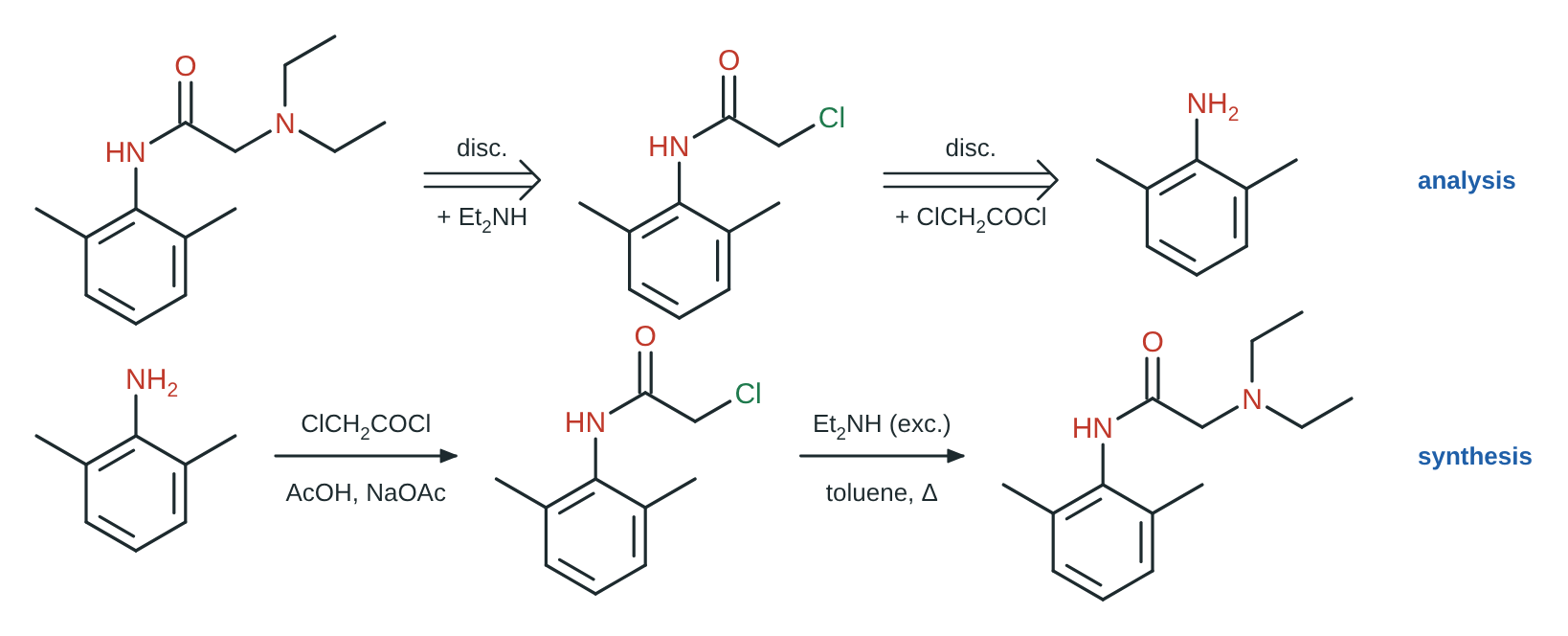
The bond between the CH2 and diethylamine is disconnected into a cationic synthon, whose equivalent is an α-chloroamide, and diethylamine as the nucleophile: a favoured SN2, because the carbon next to the carbonyl is especially reactive. Disconnection of the amide leads to 2,6-dimethylaniline and chloroacetyl chloride, a bifunctional reagent: the acyl chloride reacts with the aniline much faster than the alkyl chloride, so chemoselectivity is ensured without protecting groups.
In the laboratory, 2,6-dimethylaniline is acylated with chloroacetyl chloride in acetic acid with sodium acetate, which neutralizes the HCl; the chloroacetamide precipitates on dilution with water. It is then heated with excess diethylamine in toluene: the excess also acts as base. It is a classic experiment in organic chemistry teaching laboratories. The two ortho methyl groups are not decorative: they sterically hinder hydrolysis of the amide by amidases, which prolongs the duration of action.
Nils Löfgren and Bengt Lundqvist synthesized lidocaine in Stockholm in 1943; the company Astra marketed it in 1948 as Xylocaine. It largely replaced procaine, an ester that is hydrolysed faster and causes more allergies.