
Paracetamol
Paracetamol (acetaminophen), a universally used analgesic and antipyretic, is analysed in two steps from phenol: a disconnection of the amide and an interconversion of the amine into a nitro group.
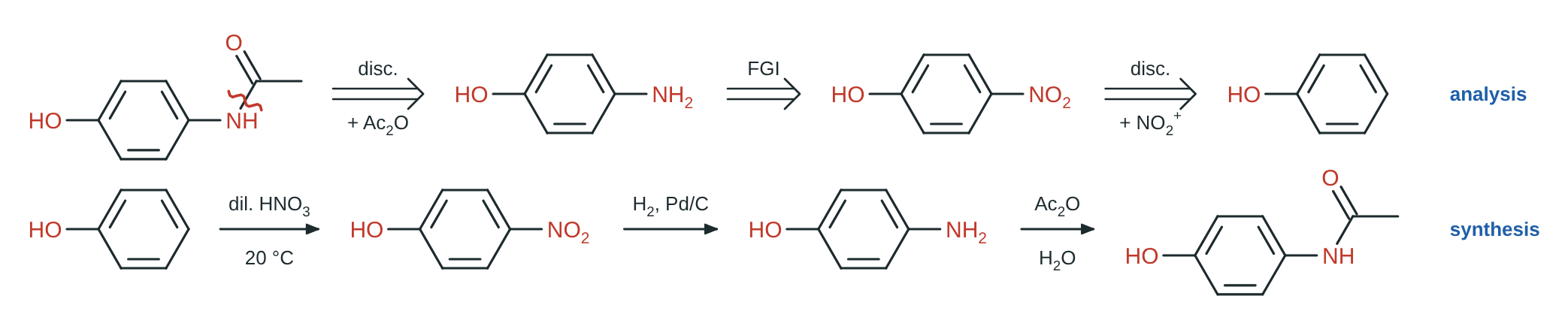
The strategic bond is that of the amide: its disconnection gives 4-aminophenol and an acylium synthon, whose equivalent is acetic anhydride. The amine, much more nucleophilic than the phenol, is selectively acetylated in water, without the need to protect the OH. The next step is to attach the nitrogen to the phenol para. OH is a strong activator and ortho/para director, which is an advantage, but nitrogen cannot be introduced as NH2: the +NH2 synthon has no direct equivalent, and the nitronium ion followed by reduction is used.
Phenol is so reactive that it is nitrated with dilute nitric acid at room temperature; a mixture of 2- and 4-nitrophenol is formed, separated by steam distillation, because the ortho isomer, with an intramolecular hydrogen bond, is volatile. Reduction of the nitro group with hydrogen and palladium, or with iron in acid, gives 4-aminophenol. Review aromatic nitration and the preparation of amines by reduction.
Harmon Northrop Morse synthesized paracetamol in 1878, but it was not used as a drug until the mid-20th century. Another industrial route starts from 4-hydroxyacetophenone, whose oxime undergoes a Beckmann rearrangement that gives the acetamide directly.