
Aspirin
Aspirin, acetylsalicylic acid, is a small molecule in which, however, several strategic bonds can be found. Analysing them one by one shows why some apparently reasonable disconnections lead to dead ends.
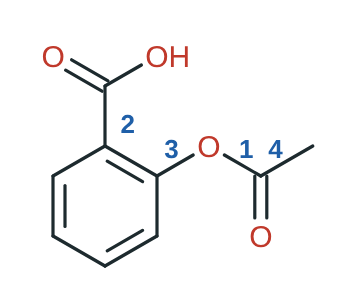
- Bond 1 (ester O–C): formed by esterification of the phenol of salicylic acid with an acetylating agent. This is the good disconnection: salicylic acid is an industrial product.
- Bond 2 (ring–COOH): it would require introducing a carboxyl ortho to the acetoxy group of phenyl acetate. Problems: the acetoxy group directs mainly para, and a ring organometallic would attack the ester.
- Bond 3 (ring–O): it would mean ortho-hydroxylation of benzoic acid. Problem: the carboxyl group directs meta.
- Bond 4 (C(O)–CH3): it would involve attack of a methyl organometallic on the carbonyl of an aryl carbonate or chloroformate. Problem: the carboxylic acid would destroy the organometallic and, protected as an ester, would also react with it.
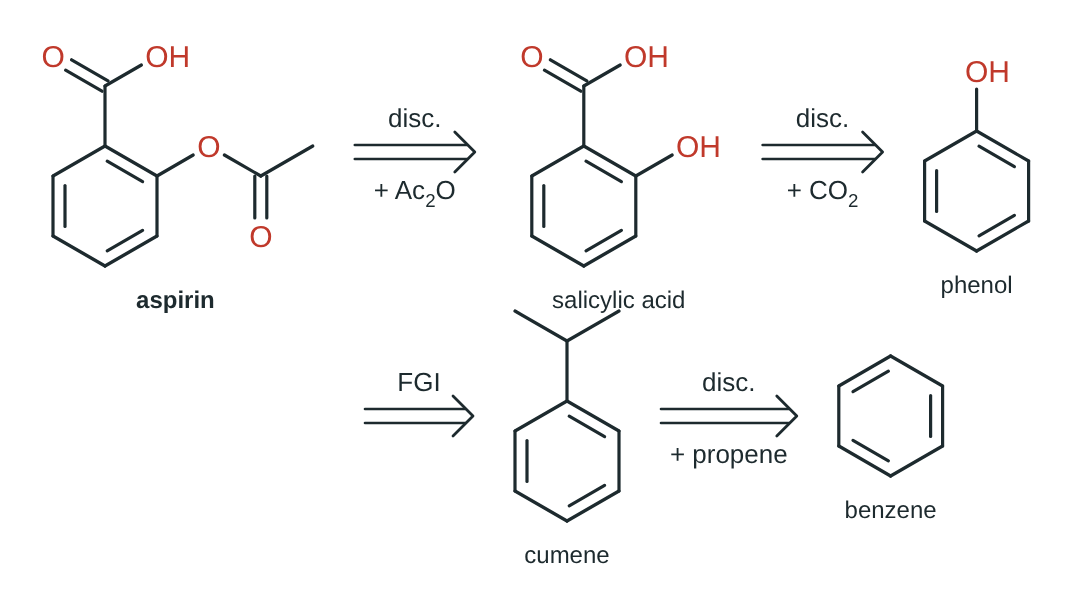
Disconnection of bond 1 leads to salicylic acid, and this, by disconnection of bond 2 in the phenoxide (not the acetate), to phenol and CO2: the Kolbe–Schmitt carboxylation, described by Hermann Kolbe in 1860 and improved by Rudolf Schmitt in 1885. The highly nucleophilic sodium phenoxide attacks CO2 under pressure, ortho, coordinated to sodium. Phenol is in turn obtained from benzene by the cumene process (Hock, 1944), which gives acetone as a by-product.
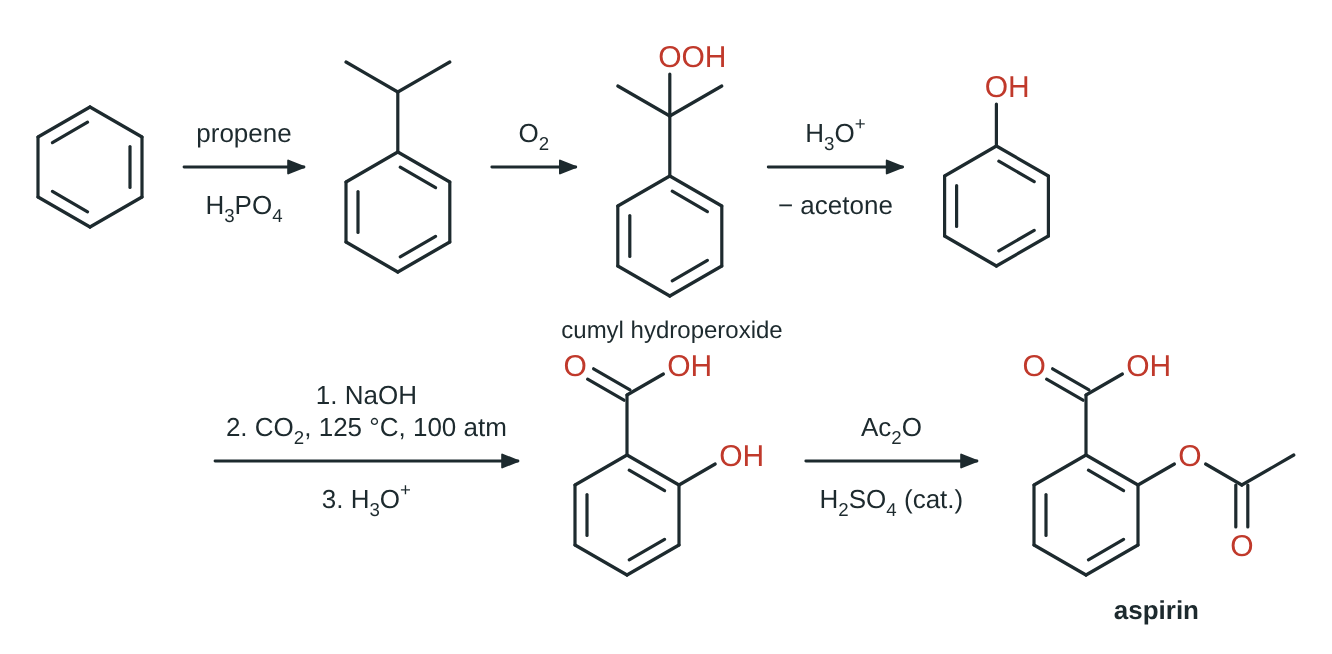
Felix Hoffmann, at Bayer, prepared pure, stable acetylsalicylic acid in 1897; Bayer registered it as Aspirin in 1899. Salicylic acid, known from willow bark, irritated the stomach; the ester is a prodrug that is hydrolysed in the body.