
Ibuprofen
Ibuprofen was discovered in the Boots laboratories (Nottingham) by Stewart Adams and John Nicholson, who patented it in 1961; it went on sale in 1969. Its manufacture is a classic example of how green chemistry has changed industrial synthesis.
The retrosynthesis of ibuprofen back to benzene and the synthesis deduced from it are discussed in the retrosynthesis section. They are textbook routes, useful for learning. Industry starts from isobutylbenzene, obtained cheaply from toluene and propene, and only has to build the propanoic acid chain in the para position.
From Boots to BHC
The original Boots route has six steps: Friedel–Crafts acylation of isobutylbenzene with acetic anhydride and AlCl3, Darzens condensation with ethyl chloroacetate, hydrolysis and decarboxylation of the glycidate to the aldehyde, oxime formation, dehydration to the nitrile and hydrolysis. It consumes stoichiometric amounts of AlCl3 and its atom economy is only 40%: more than half of the mass of the reagents ends up as waste.
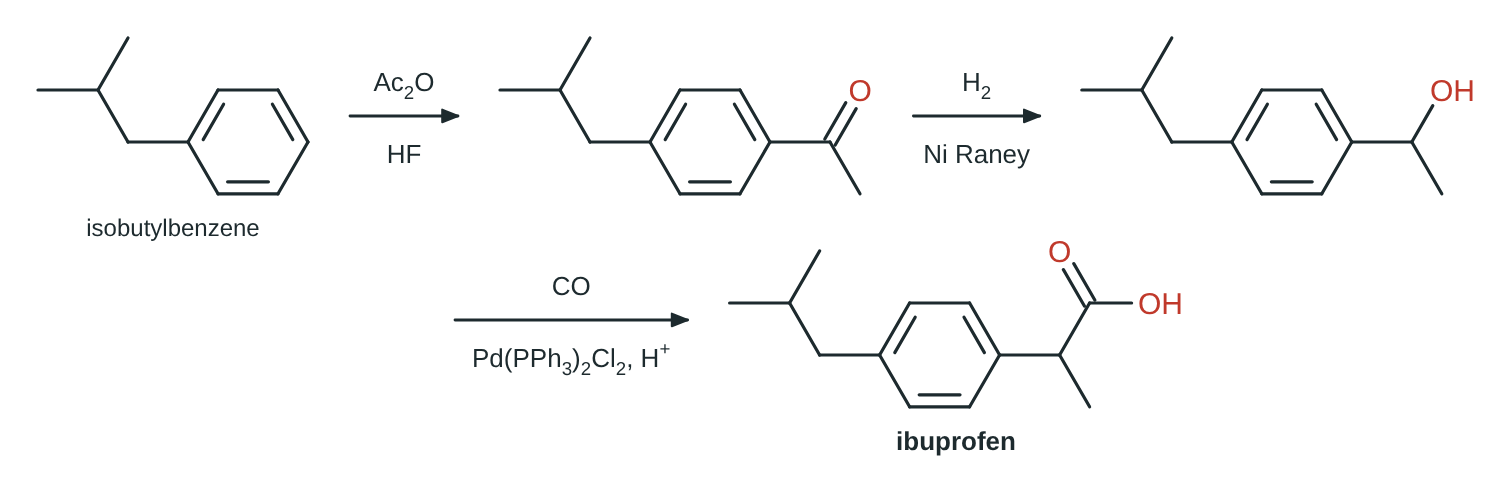
The BHC process (Boots, Hoechst and Celanese), operating since 1992, does it in three catalytic steps: the acylation uses HF, which acts as catalyst and solvent and is recovered; the ketone is hydrogenated to the alcohol with Raney nickel; and the alcohol is carbonylated directly with CO and a palladium catalyst, which introduces the carboxyl group at the benzylic carbon. The atom economy rises to 77%, and almost 100% if the acetic acid formed in the first step is used. It received the US Presidential Green Chemistry Award in 1997.
Palladium-catalysed carbonylation is a relative of the cross-couplings of topic 9: oxidative addition, CO insertion and release of the product.