
Retrosynthetic analysis
The analysis ends when affordable starting materials are reached. The scheme is then reversed: each ⇒ arrow becomes a reaction arrow (→) with its reagents and conditions, and each step is checked for compatibility with all the groups present.
Reversing the retrosynthesis of ibuprofen gives a seven-step synthesis from benzene. The two Friedel–Crafts acylations are carried out in the right order: the first introduces the isobutyryl group, which the Clemmensen reduction converts into isobutyl; this alkyl group, activating and ortho/para-directing, sends the second acylation to the less hindered para position.
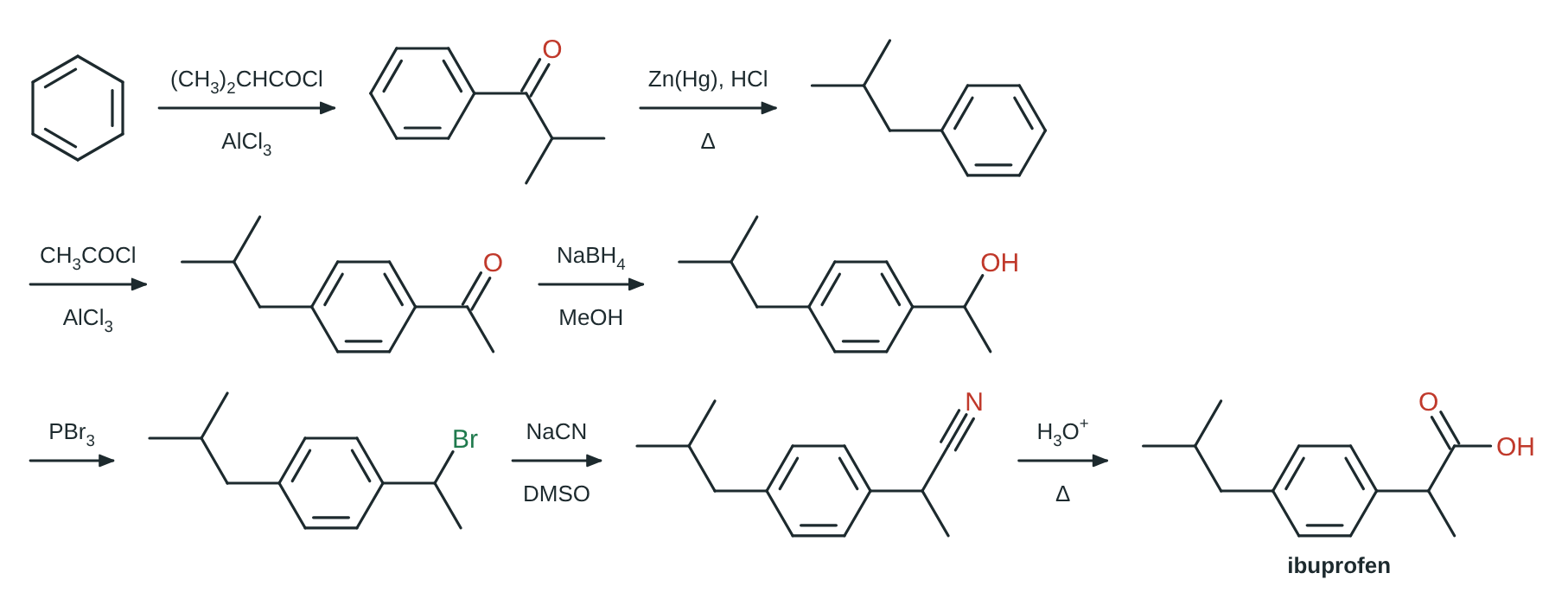
The analysis also makes it possible to judge the route. This one is logical but long, and substitution on a secondary benzylic bromide competes with elimination. The industrial syntheses of ibuprofen start from isobutylbenzene and have six steps (Boots, 1961) or only three (BHC process, 1992); they are compared in the ibuprofen example. To evaluate a synthesis one counts the steps of the longest sequence, the overall yield (the product of the yields of each step), the atom economy and the cost and hazards of the reagents.
A linear synthesis chains the steps one after another; a convergent one prepares fragments separately and joins them at the end. With ten steps at 80%, the linear route gives 11%; if two five-step fragments are built and joined, the yield over the longest sequence is 26%. That is why complex molecules, such as epothilone, are synthesized convergently.