
The target molecule
Before disconnecting anything, the target molecule must be read: what functional groups it has, what its carbon skeleton is, and what stereocentres and relationships between groups (1,2; 1,3; 1,5…) it contains. Each feature suggests a reaction.
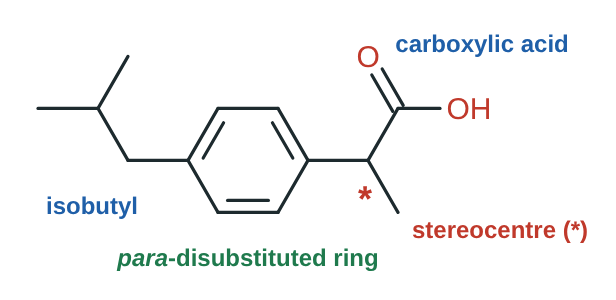
In ibuprofen one recognizes: a carboxylic acid, which may come from a nitrile, from a Grignard reagent and CO2 or from oxidation of an alcohol or aldehyde; a stereocentre at the α carbon, although the drug is sold as the racemate (the active enantiomer is (S), and the body partly converts the (R) into it); a para-disubstituted benzene ring, which points to electrophilic aromatic substitution and to the orientation of the groups; and an isobutyl group, whose carbon attached to the ring cannot be introduced by direct alkylation.
It is also worth asking which commercial compounds resemble the target molecule. A skeleton that already exists in a cheap product (here isobutylbenzene, which industry obtains from toluene and propene) saves steps. And attention must be paid to groups that could get in the way: a carboxylic acid destroys organometallics, so that, if one is involved, the acid must appear at the end or be protected (see protection of functional groups).