Nomenclature
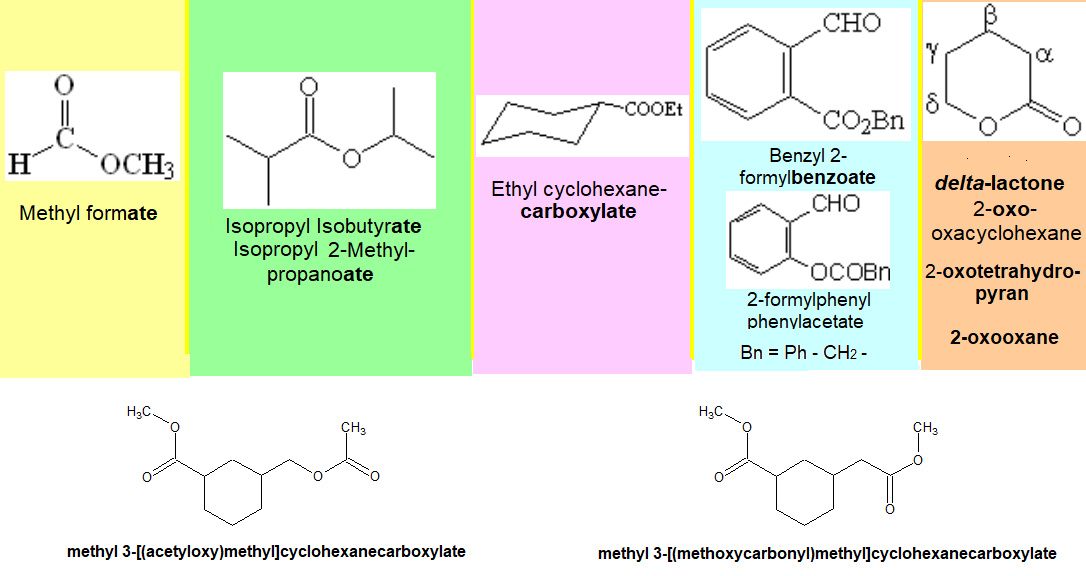
Nomenclature rules are complex. We will only attempt to give names to relatively simple molecules. Look at the following examples of representative molecules bearing ester groups.
 ▶ Watch the video on YouTube
An ester comes from the condensation of a carboxylic acid and an alcohol (acid + alcohol = ester + water). Analogously to the inorganic salts (acid + base = salt + water), esters are named as if they were acid salts (carboxylates), the imaginary counterion being an alkyl radical.
- The ester function is almost always the principal one.
- When it isn't, it is named as alkyloxycarbonyl or alkylcarbonyloxy, depending on whether it is bonded to the main chain by the carbonyl group or by the alcohol oxygen, respectively.
- As usual, in both moieties (that derived from the acid and the other from the alcohol) the longest possible chain containing the largest possible number of other functions is selected.
- The main chain is ended by the suffix "ate" or "carboxylate".
- The numbering starts by the ester function.