Skip to content
qorganica.es qorganica.comOrganic Chemistry made transparent Course map Español

Reactivity

Anhydrides are close in reactivity to acyl halides as explained as well by the negligible contribution of the resonance form with the positive charge on the L (carboxylate) group.

Resonance forms of an acyl halide

The mechanism is the usual addition-elimination process.

Addition–elimination mechanism of a nucleophile with an acyl halide: tetrahedral intermediate and loss of HX

The versatility of the anhydride function is not as wide as that of acyl chlorides. Please, notice that a carboxylate instead of chloride is always obtained as by-product.
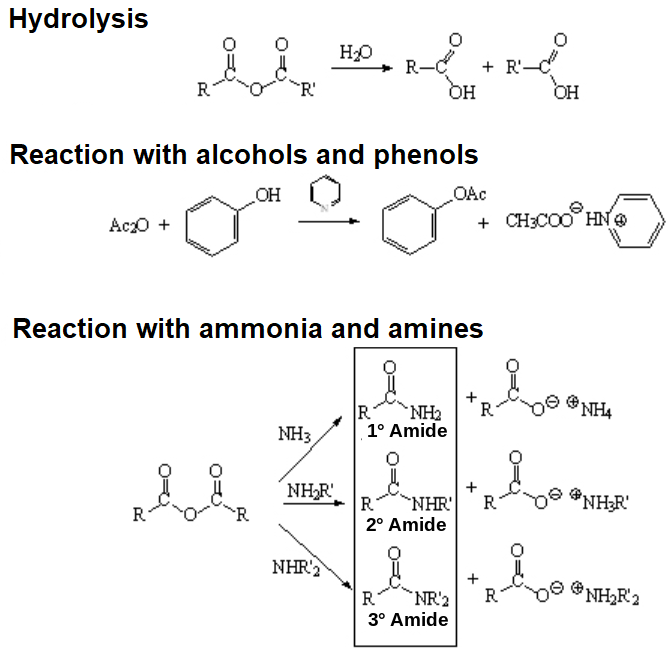
Reactions of anhydrides: hydrolysis to two carboxylic acids, reaction with phenol in pyridine to give the ester, and with ammonia or amines to give primary, secondary or tertiary amides plus the ammonium salt of the acid