Combustion
The combustion of alkanes is a very important reaction that directly affects our everyday life. It is one of the most important sources of energy in our contemporary society.

Burning an alkane releases on average about 165 kcal/mol per carbon or, in general, an organic compound.
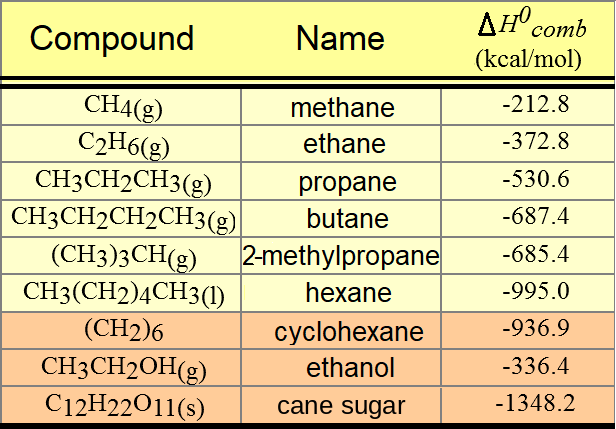
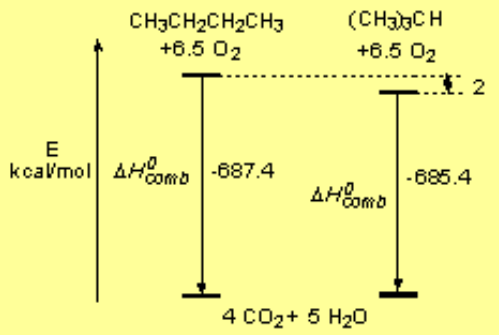
Heats of combustion are experimental numbers that allow us to estimate the relative stability of alkanes bearing the same number of carbons.
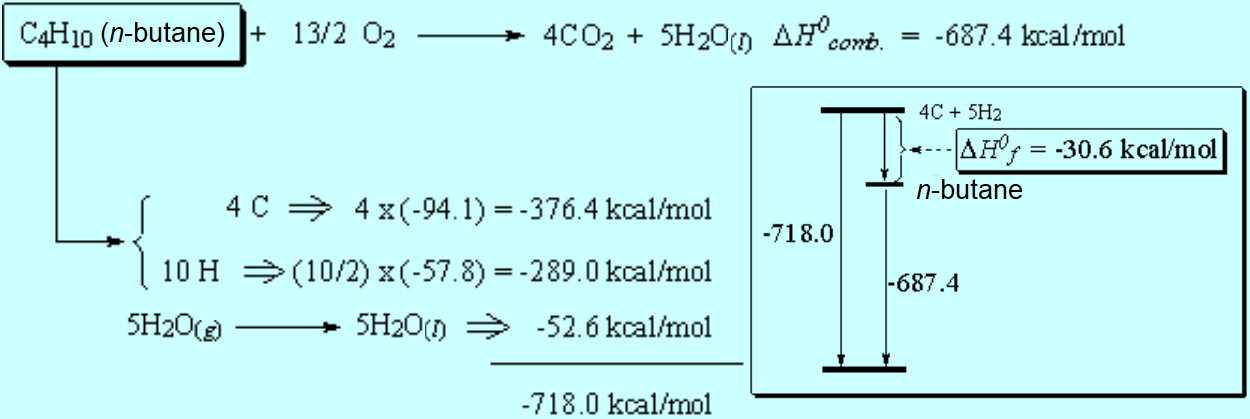
Measured heats of combustion allow us to obtain heats of formation, using the heats of combustion of the two main elements (C and H2) and taking into account the heat of vaporization of water.
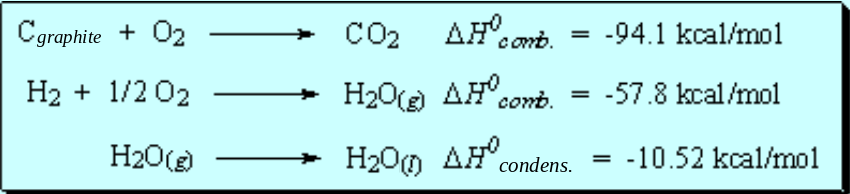
The difference between the 'real' heat of combustion and the 'theoretical' one calculated from the elements is the heat of formation. If the latter ends up as a negative value, it means that the compound is more stable than its isolated elements. This is the usual case, but it does not always happen.