
SolutionsBimolecular Elimination
1. Why the Z isomer?
Propose a mechanism showing why the Z isomer is formed in this reaction.
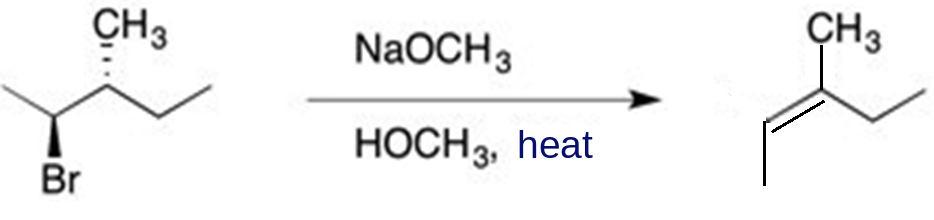
The mechanism that explains this reaction is E2, in which the leaving group and the hydrogen on the adjacent carbon leave the molecule at the same time, by the action of the base. The stereochemical requirement is that both the leaving group and the proton must be antiperiplanar.
There is only one conformation of the substrate in which the bromine on C2 and the only hydrogen on C3 are antiperiplanar. In it, the methyl group on C2 is on the same side as the ethyl group on C3, and this arrangement is kept in the double bond: the Z alkene is formed.
2. Kinetics
In an E2 reaction the concentration of the base is doubled. What happens to the rate?
It doubles: v = k[RX][B−]. The base is involved in the single transition state.
3. The 1-bromo-4-tert-butylcyclohexanes
Why does the cis isomer eliminate HBr with KOH much faster than the trans isomer?
The very bulky tert-butyl group always stays equatorial. In the cis isomer the bromine is then axial, antiperiplanar to the axial hydrogens of the adjacent carbons, and E2 is easy. In the trans isomer the bromine is equatorial and has no antiperiplanar hydrogen.
4. Small and bulky bases
Which alkene predominates in the E2 reaction of 2-bromo-2-methylbutane with sodium ethoxide? And with potassium tert-butoxide?
With ethoxide, 2-methyl-2-butene, the more substituted alkene. With tert-butoxide, a very bulky base, 2-methyl-1-butene predominates, because it more easily removes a hydrogen from the less hindered methyl groups.