Nomenclature
Halogenated compounds are omnipresent in our daily life: furniture, pipes, solvents, insecticides, synthetic intermediates, etc. Natural products containing only halogens are rare, but some contain halogens together with other functional groups. Here is an important example.

Thyroxine
Substance secreted by the thyroid gland: it influences growth, development and maturation of the organism, regulation of basal metabolism, etc.
Halogens can be attached to alkyl, aryl or alkenyl chains. In this chapter we will only consider alkyl halides, i.e. those compounds where the halogens are bonded to sp3 carbons. The other ones display very different properties and will be studied elsewhere.

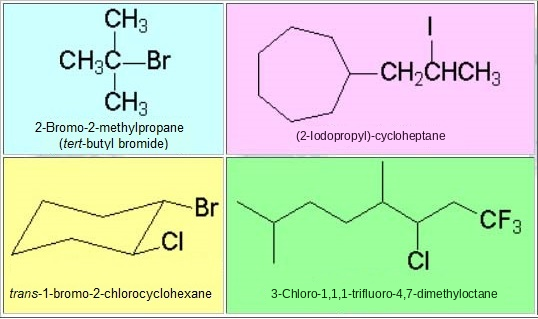
In the IUPAC nomenclature, a halogen is considered, within the main chain, as a substituent with its locant. Only very simple compounds can be named as alkyl halides.