
SolutionsAlkenes
1. Reactions of 2-methyl-1-phenylcyclohexene
Starting from 2-methyl-1-phenylcyclohexene, predict the outcome of the reactions in the table:
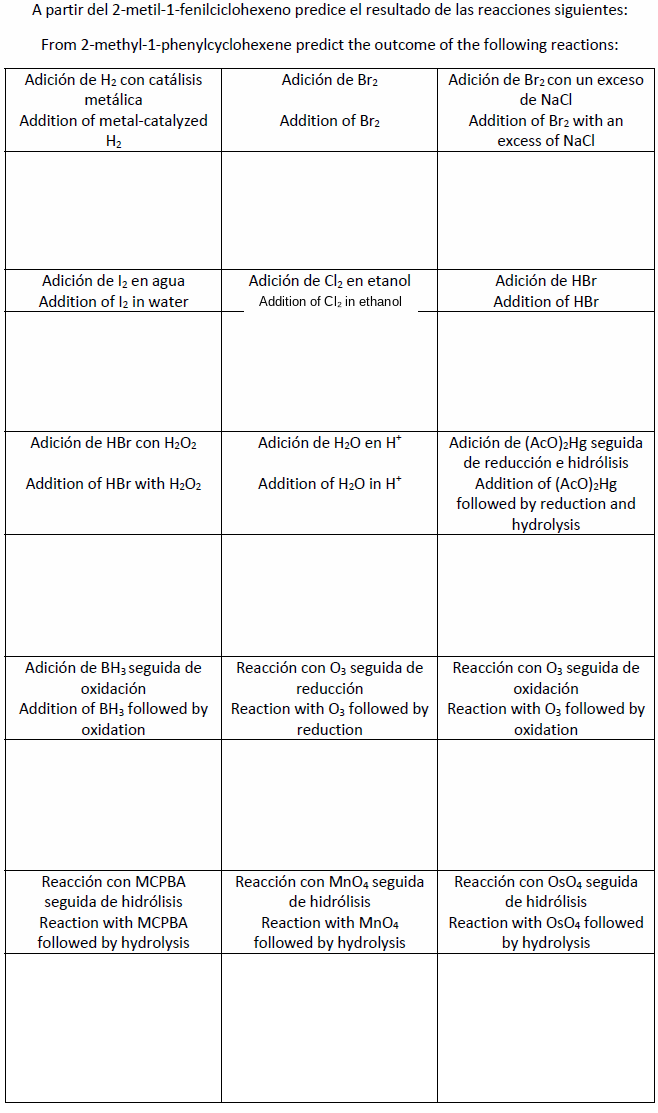

There are three keys: the carbocation (or the quasi-carbocation of the halonium or mercurinium ion) forms on the benzylic, tertiary carbon, which stabilizes it best; additions through cyclic ions are anti; hydrogenation, hydroboration and dihydroxylation with MnO4− or OsO4 are syn additions.
2. Which reagent would you use?
Give the reagent or sequence of reagents to convert 1-methylcyclohexene into:
- Methylcyclohexane
- 1-Methylcyclohexanol
- trans-2-Methylcyclohexanol
- cis-1-Methylcyclohexane-1,2-diol
- 6-Oxoheptanal
- H2, Pd/C.
- H2O/H+ or, better, oxymercuration-demercuration ((AcO)2Hg, H2O; NaBH4).
- Hydroboration-oxidation: BH3 then H2O2, HO−.
- OsO4 (or cold dilute KMnO4) then hydrolysis.
- Ozonolysis with reductive work-up: O3 then (CH3)2S or Zn/AcOH.
3. Degrees of unsaturation
A hydrocarbon C6H10 takes up 1 mol of H2 on catalytic hydrogenation. How many rings does it have? Propose a structure.
C6H10 has (2·6 + 2 − 10)/2 = 2 degrees of unsaturation. Since there is only one double bond (1 mol of H2), the other degree is a ring: for example, cyclohexene.