
SolutionsElimination Reactions
1. Alcohols and bromides
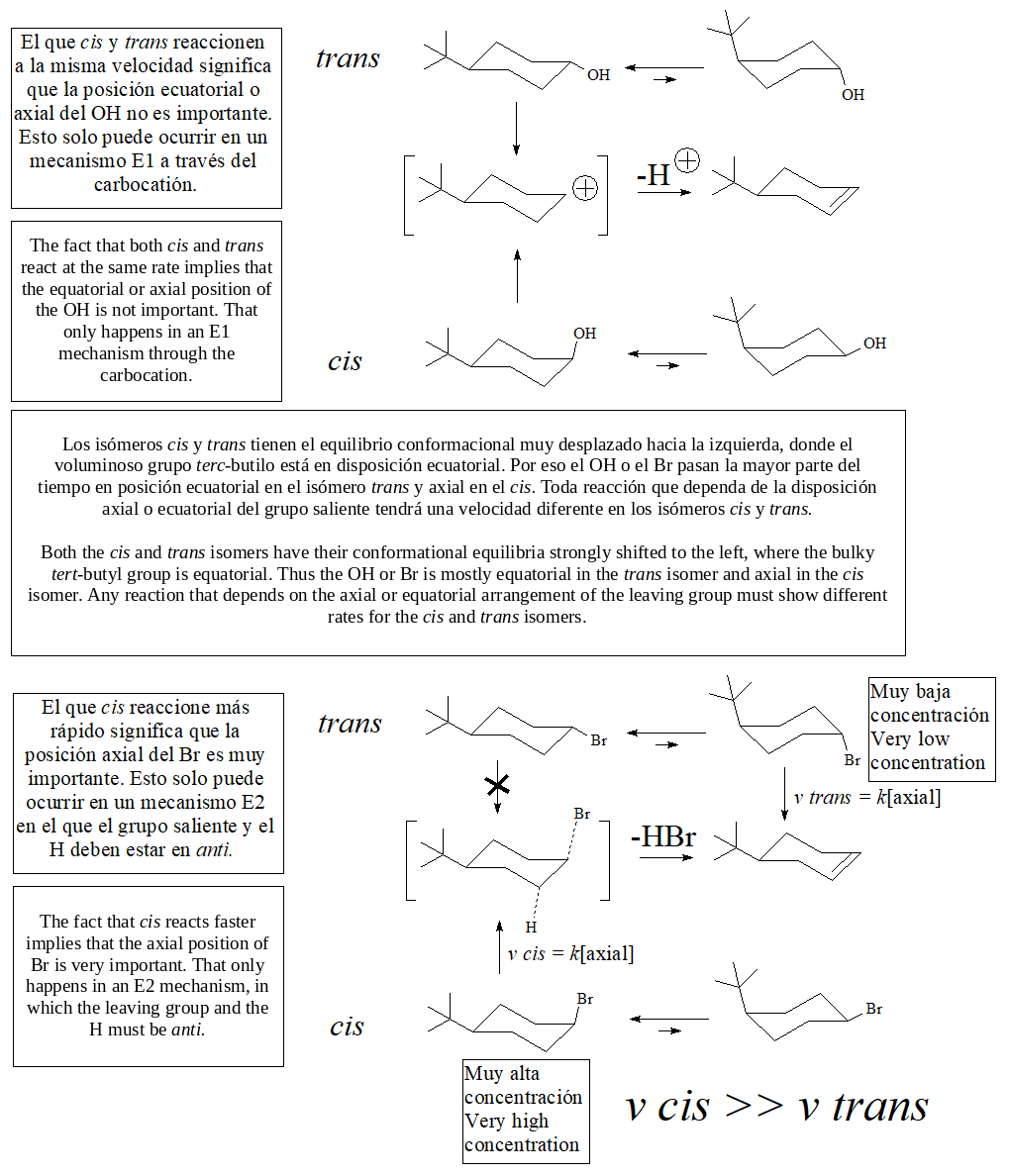
Explain the following facts: the cis and trans isomers of 4-tert-butylcyclohexanol dehydrate at very similar rates in H2SO4 at high temperature. However, the cis isomer of 1-bromo-4-tert-butylcyclohexane eliminates HBr with a strong base much faster than its trans isomer.
2. Saytzev or Hofmann
Give the major olefin in the elimination of 2-bromo-2-methylbutane with: a) sodium ethoxide in ethanol; b) potassium tert-butoxide in tert-butanol.
- 2-Methylbut-2-ene, the more substituted olefin (Saytzev): the small ethoxide removes the hydrogen of the CH2.
- 2-Methylbut-1-ene, the less substituted one (Hofmann): the bulky tert-butoxide removes the most accessible hydrogen, one of a CH3.
3. E2 stereochemistry
Which alkene is formed in the E2 elimination of (2R,3S)-2-bromo-3-methylpentane?
(Z)-3-Methylpent-2-ene. In E2 the H and the Br must be anti; when they are placed that way in the (2R,3S) isomer, the CH3 on C2 and the ethyl on C3 end up on the same side of the new double bond.
E2 is stereospecific: each stereoisomer of the substrate gives one particular isomer of the alkene.