
SolutionsPhysical and Bond Properties
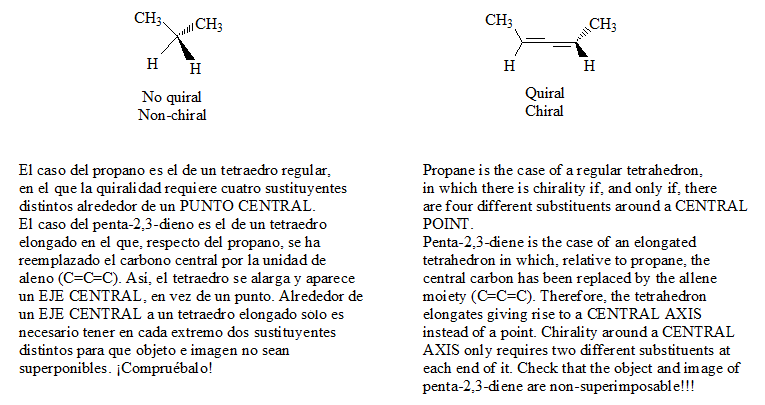
1. A chiral allene
Explain why penta-2,3-diene is chiral whereas propane is not.

2. Rotation about the central bond
Explain why rotation about the central bond of buta-1,3-diene costs about 3 kcal/mol more than in ethane.

A "normal" double bond has a rotation barrier of about 65 kcal/mol: the double-bond character of the central bond of butadiene is small, but noticeable.
3. Bond lengths
Order from shortest to longest: the C2–C3 bond of butadiene, the C=C bond of ethylene and the C–C bond of ethane.
C=C of ethylene (1.34 Å) < C2–C3 of butadiene (1.47 Å) < C–C of ethane (1.54 Å).
The central bond of butadiene is shorter than a normal single bond because it joins two sp2 carbons and has a slight double-bond character.