Acid-Base Properties
The O-H bond is stronger (ΔH0 = 104 kcal/mol) than the C-H bond (ΔH0 = 98 kcal/mol) and yet it is much easier to break heterolytically. How come?
The heterolytic cleavage of an O-H bond produces an alkoxide where the negative charge is placed on an oxygen, much more electronegative than a carbon.
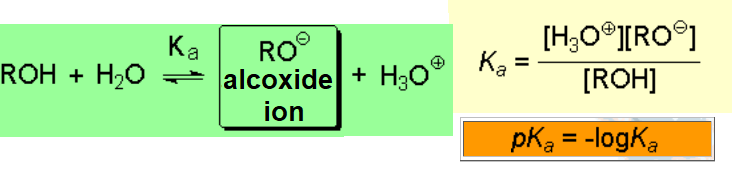
The acidity of an alcohol can be qualitatively understood in terms of the relative stability of the resulting alkoxide.
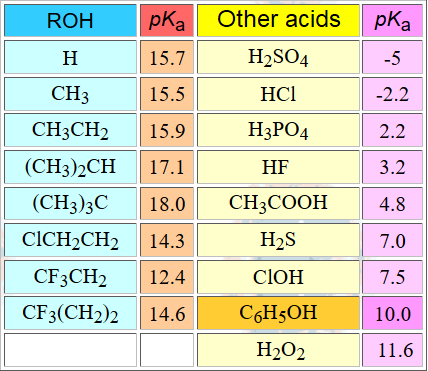
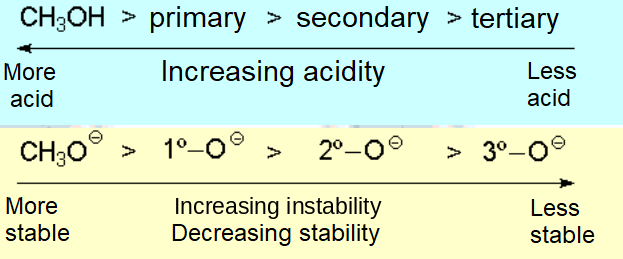
Acidity decreases from methanol to primary, secondary and tertiary alcohols. The more alkyl groups surround the oxygen, the harder it is for solvent molecules to approach and stabilize (solvate) the negative charge of the alkoxide; moreover, alkyl groups donate some electron density and concentrate that charge even further. The tertiary alkoxide is the least stable and, therefore, the tertiary alcohol is the least acidic.
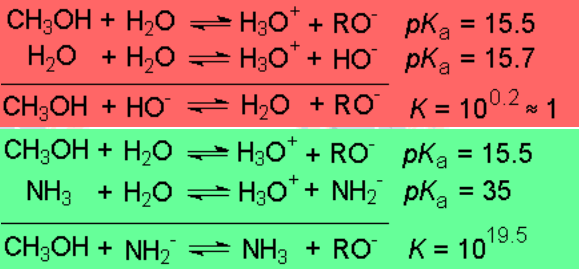
One needs relatively strong bases to quantitatively convert alcohols into their conjugate bases, the alkoxides:
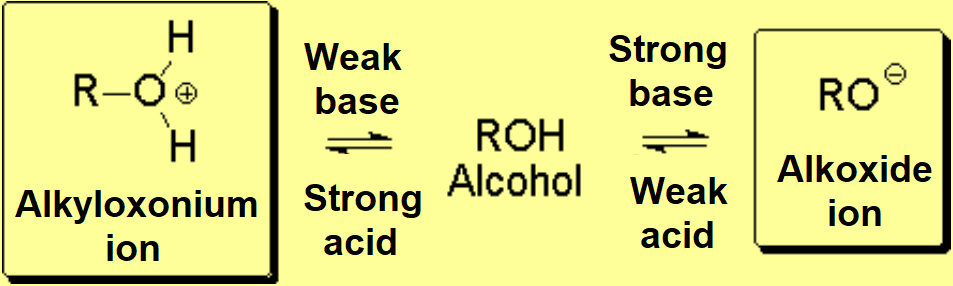
Alcohols are amphoteric because the lone electron pairs on the oxygen can be shared with an external acid, provided it is a strong one.