Skip to content
qorganica.es qorganica.comOrganic Chemistry made transparent Course map Español

Preparation and Reactivity

In general, sulfur compounds can be obtained by nucleophilic substitution with the proper sulfur derivative. The reactivity of thiols and sulfides is close to that of alcohols and ethers, respectively.

Overview of preparation methods
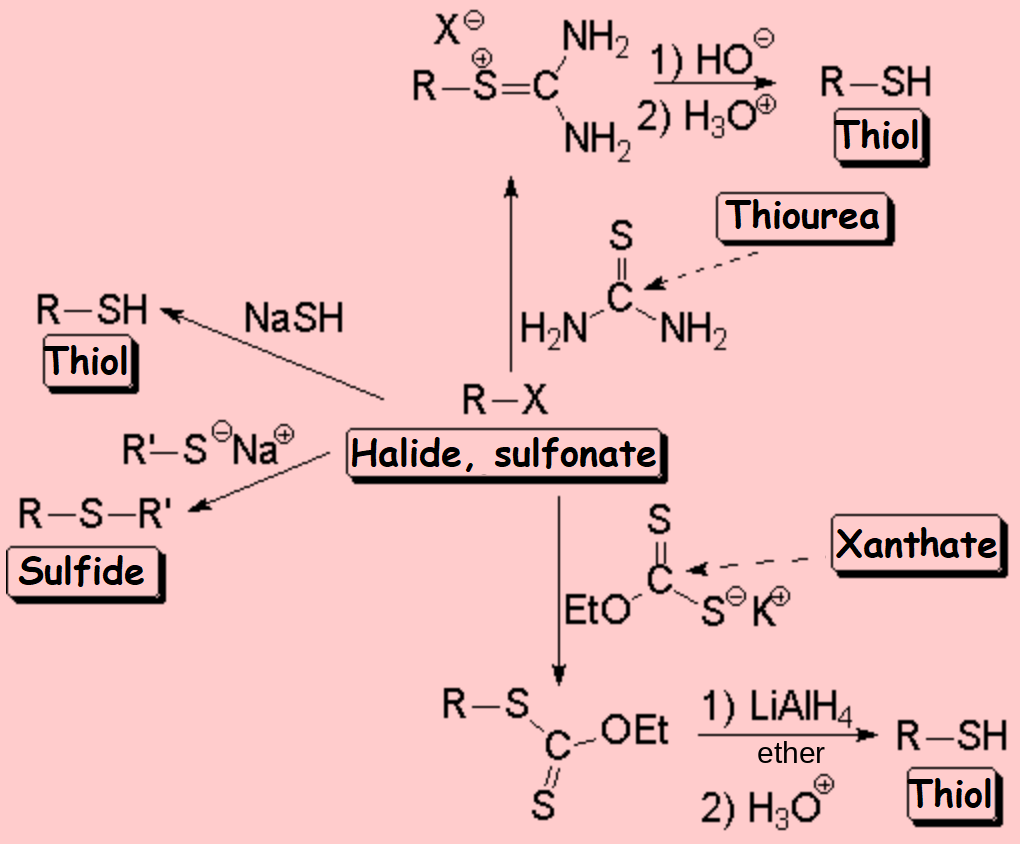
Preparation of thiols and sulfides from halides or sulfonates: with NaSH, with thiourea followed by hydrolysis, with thiolates R′S− and with xanthate followed by reduction with LiAlH₄

Reactivity

Sulfur has empty d orbitals and can accommodate more than 4 electron pairs. That makes sulfur able to undergo reactions not possible in alcohols and ethers:

Oxidation of methanethiol with KMnO₄ to methanesulfonic acid
Oxidation of dimethyl sulfide to dimethyl sulfoxide and to dimethyl sulfone, with their melting and boiling points
Dimethylsulfide
Dimethylsulfoxide
Dimethylsulfone

An important reaction of thiols is their relatively easy oxidation to disulfides:

Oxidation of two molecules of methanethiol with iodine to dimethyl disulfide (m.p. −85 °C, b.p. 109 °C)
2 x Methylthiol
Dimethyldisulfide

This 'disulfuration' reaction - disulfide formation - is very important in biology.

Biological process: two cysteines of a peptide chain come close through a conformational change and their oxidation forms a disulfide bridge that changes the shape of the protein

For instance, insulin is made of two polypeptide chains (A and B) bonded together by disulfide bridges (marked in yellow). The model shows two insulin molecules, i.e. four chains.

Insulin