
Nomenclature and Properties
The corresponding sulfur compounds to alcohols and ethers are thiols and thioethers - sulfides -, respectively.
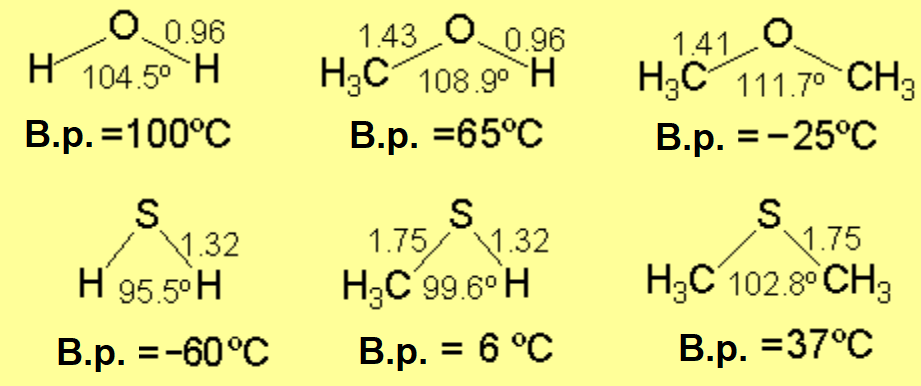
The S-H···S hydrogen bond is much weaker than the O-H···O.
The lower b.p. of hydrogen sulfide and methylthiol as compared to water and methanol, respectively, is proof of that.
However, dimethyl sulfide displays a higher b.p. than its oxygen homolog. This is a consequence of the larger size and polarizability of the sulfur atom, since no hydrogen bonding is possible in these compounds.
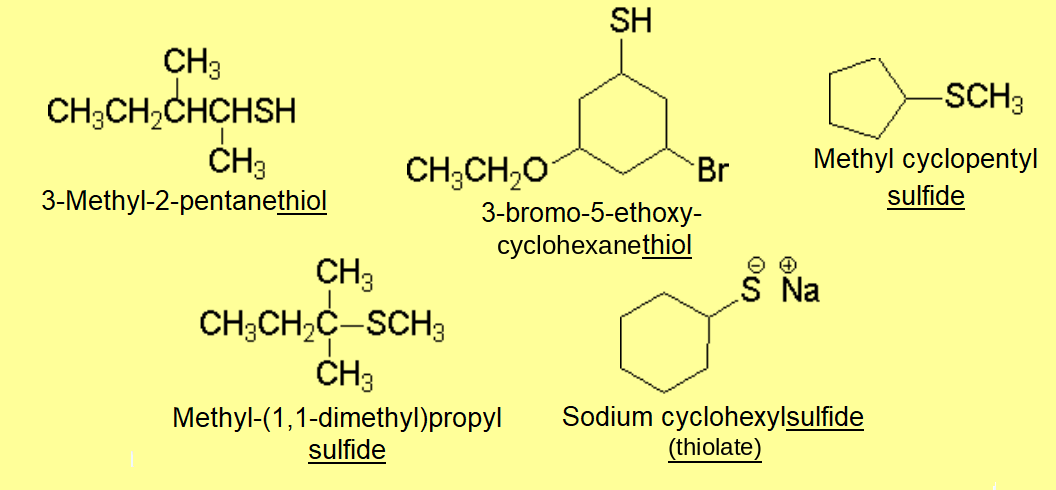
Some simple examples of nomenclature:
Thiols are more acidic than alcohols:

Sulfur is larger than oxygen and thus better able to delocalize the negative charge. Therefore, the sulfide anion is more stable and hence less basic than the corresponding alkoxide.