Acid-Base Properties
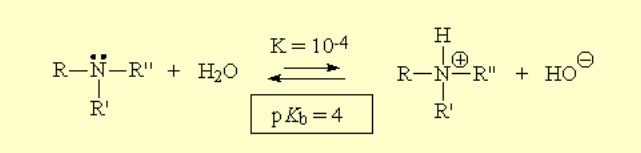
Amines are moderately basic and the corresponding ammonium salts - their conjugate acids - are moderately acidic.
 ▶ Watch the video on YouTube
Protonation of amines
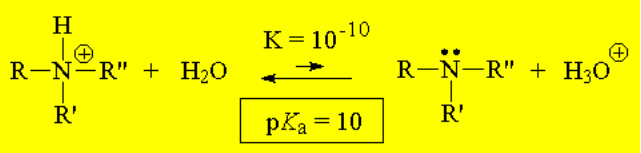
Deprotonation of ammonium salts
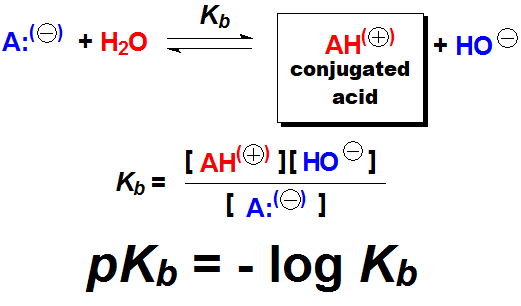
The higher the basicity, the further the equilibrium lies to the right, i.e. towards the formation of HO−, the higher Kb and the lower pKb.
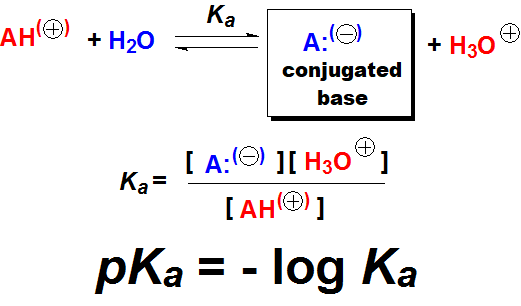
The higher the acidity, the further the equilibrium lies to the right, i.e. towards the formation of H+ (H3O+), the higher Ka and the lower pKa.
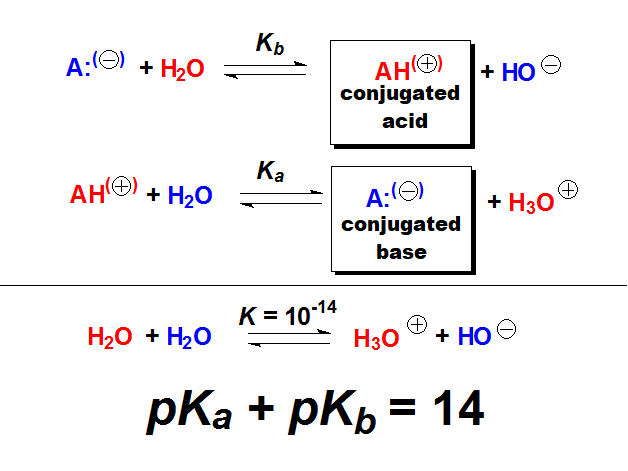
pKa and pKb values are related through the ionic product of water. Therefore, from the pKa of an acid, the pKb of its conjugate base can be calculated by subtracting it from 14, and vice versa.


Amines with at least a N-H group are very weakly acidic. Accordingly, their conjugate bases, the metal amides, are extraordinarily strong bases.
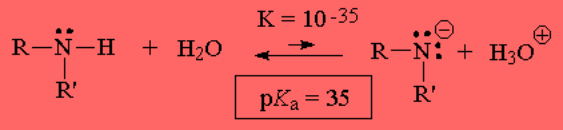
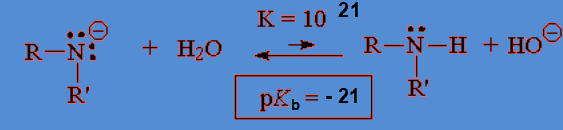
Acidity of alkanes is minimal (pKa > 50). The acidity of amines is also low (pKa=35) but ca. 15 orders of magnitude higher. That means that the N− anion is more stable than the C− carbanion coming from an alkane. This can be understood in terms of the higher electronegativity of the nitrogen as compared to carbon.
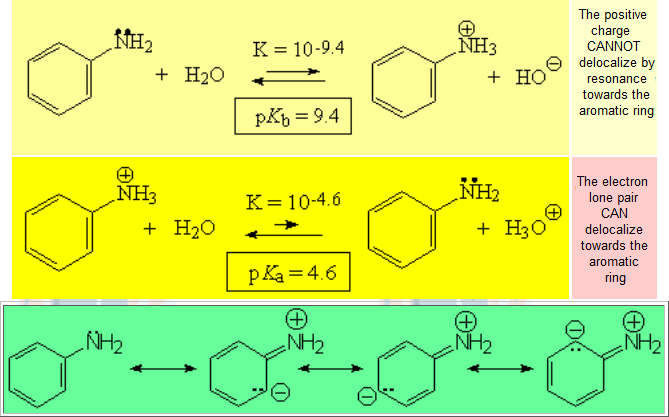
Aromatic amines (anilines) are less basic than amines because the nitrogen lone pair is less available to an external acid, owing to resonance and delocalization into the aromatic ring. Consequently, anilinium salts are more acidic than ammonium salts.