
SolutionsAcid-Base Properties
1. Keto-enol equilibria
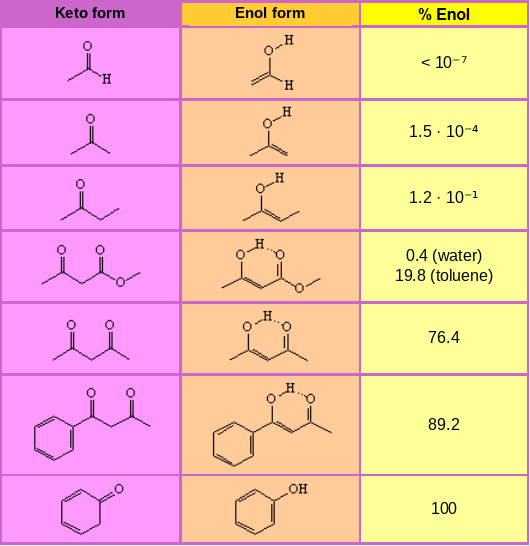
Explain the shifts of the following keto-enol equilibria:
| Compound | Explanation |
|---|---|
| Acetaldehyde | Monosubstituted double bond; no hydrogen bond: very unstable enol. |
| Acetone | Disubstituted double bond, somewhat more stable; no hydrogen bond. |
| Butanone | Trisubstituted double bond, more stable still; no hydrogen bond. |
| Methyl acetoacetate | Trisubstituted double bond conjugated with the other carbonyl; intramolecular hydrogen bond, which is effective in a nonpolar solvent (toluene) and competes with water. |
| 2,4-Pentanedione | As above, but the second carbonyl is a ketone: there is no conjugation of the OMe with the ester C=O, which stabilizes the keto form. |
| 1-Phenyl-1,3-butanedione | The above reasons plus conjugation with the aromatic ring. |
| Cyclohexa-2,4-dienone | The enol is phenol, which is aromatic; the keto form is not. |
2. A chiral ketone in base
Could you predict what would happen to (S)-3-phenyl-2-butanone when treated with a base?
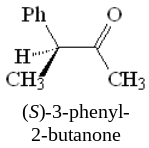

It racemizes. The base removes the hydrogen of the stereogenic carbon, which is an α carbon. The enolate is planar and is protonated equally on both faces, so an equimolar mixture of the R and S enantiomers is obtained.
3. A cyclohexanone in base
Could you foretell what will happen to cis-2,5-dimethylcyclohexanone in basic medium?


It epimerizes at C2, which is an α carbon. Through the enolate, the methyl on that carbon can go from axial to equatorial and the trans isomer, with both methyl groups equatorial, forms; it is more stable and predominates at equilibrium. C5 is not an α carbon and does not change.
4. Butanone in heavy water
What about butanone, if we dissolve it in deuterated water in basic medium?
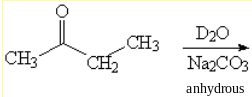

The five α hydrogens, those of the CH3 and of the CH2, are exchanged for deuterium through the two possible enolates. With excess D2O, 1,1,1,3,3-pentadeuterobutanone is obtained. The hydrogens of the other methyl group, which is not α, are not acidic and are not exchanged.
5. Epimerization and deuteration
A few minutes after dissolving the pure trans diastereomer of 2-methyl-4-tert-butylcyclohexanone in aqueous ethanol containing a catalytic amount of NaOH, the cis isomer starts to appear and ends up being the major component of the mixture. Besides, when ethanol-d (CH3CH2OD) and NaOD are used, the same cis-trans mixture is obtained, but of 2,6,6-trideutero-2-methyl-4-tert-butylcyclohexanone. Propose a mechanism that explains these transformations.

The tert-butyl group locks the conformation with itself equatorial. In the trans isomer the C2 methyl is axial. The base forms the enolate and, on reprotonation, C2 can receive the proton on either face: the cis isomer, with the methyl equatorial, forms; it is more stable and becomes the major one.
With EtOD and NaOD, every time an enolate forms the α carbon is reprotonated with deuterium. The hydrogen at C2 and the two at C6 (the three α hydrogens) are thus exchanged, while the cis/trans equilibrium is the same.