Skip to content
qorganica.es qorganica.comOrganic Chemistry made transparent Course map Español

SolutionsRobinson Annulation

1. Which compounds are A and B?

Which compounds are A and B?
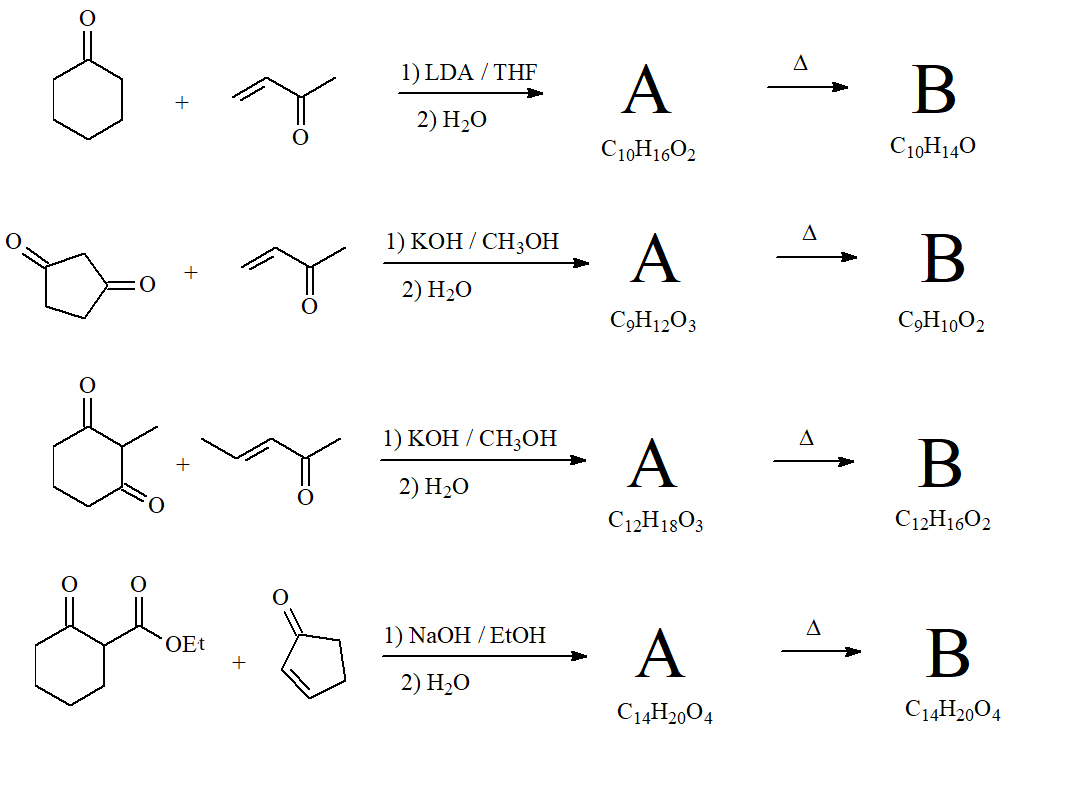
Four Robinson annulations with their molecular formulas: cyclohexanone and methyl vinyl ketone; 1,3-cyclopentanedione and methyl vinyl ketone; 2-methyl-1,3-cyclohexanedione and 3-penten-2-one; ethyl 2-oxocyclohexanecarboxylate and 2-cyclopentenone
Solutions: the bicyclic aldols A and the α,β-unsaturated ketones B; in the fourth case the aldol does not dehydrate because of Bredt’s rule; below, the general mechanism

In each case, the enolate of the first ketone undergoes a Michael addition to the α,β-unsaturated ketone and the resulting dione undergoes an intramolecular aldol condensation: A is the bicyclic aldol. On heating, A dehydrates to the conjugated cyclohexenone B (it loses H2O, as the formulas show).

In the fourth example A and B have the same formula, C14H20O4: the aldol is a bridged system and the double bond would have to be at a bridgehead, which prevents dehydration (Bredt’s rule).
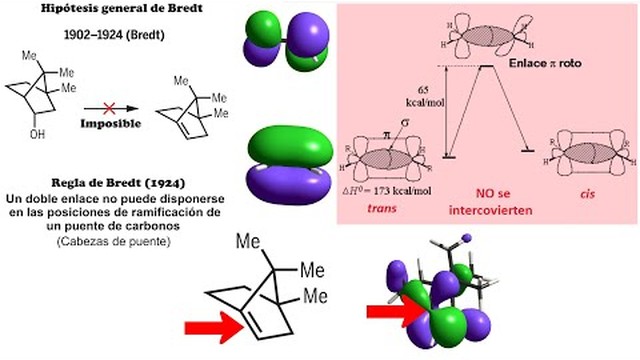
Video (in Spanish): Bredt’s rule (a double bond cannot be placed at a bridgehead)▶ Watch the video on YouTube

← Back to the exercises