HMBC case studies
We finish the case of compound C7H14O6. HMBC answers the two questions the HSQC left open: where the OCH3 is and which oxygen closes the ring. The result is a sugar, methyl β-D-glucopyranoside.
What we know
With the 1H spectrum, COSY, 13C and HSQC we had reached this partial structure: a chain of five CH groups and one CH2, all bonded to oxygen, with the first CH (4.72 / 102.1 ppm) bonded to two oxygens, and an isolated OCH3. Of the eight positions bearing oxygen, two must be shared oxygens.
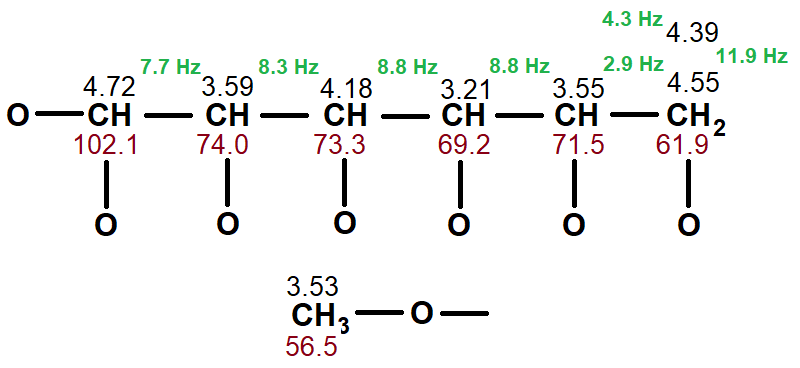
Three unknowns remain:
- Which groups is the CH at 4.72 / 102.1 ppm joined to through its two oxygens?
- Which other carbon shares an oxygen to close the ring?
- Where is the OCH3 attached?
The HMBC
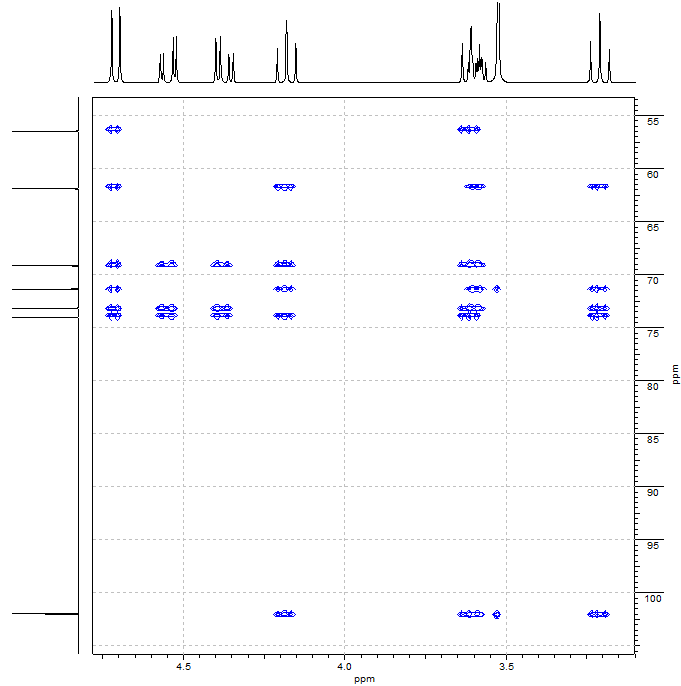
We focus on the correlations of the key player, the CH at 4.72 / 102.1 ppm. They must be looked for in two directions: in the column of the hydrogen at 4.72 ppm and in the row of the carbon at 102.1 ppm.
The column of the H at 4.72 ppm. This hydrogen correlates with the six carbons it is not directly bonded to: 74.0, 73.3, 71.5, 69.2, 61.9 and 56.5 ppm.
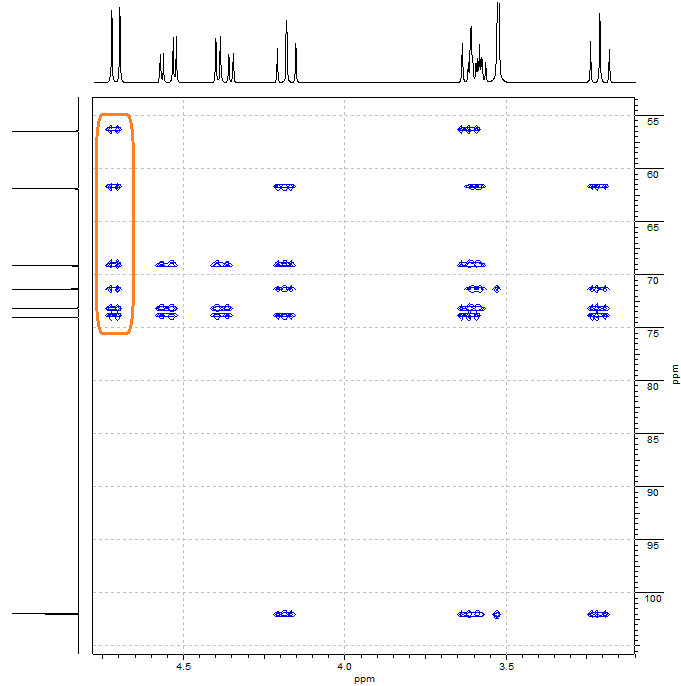
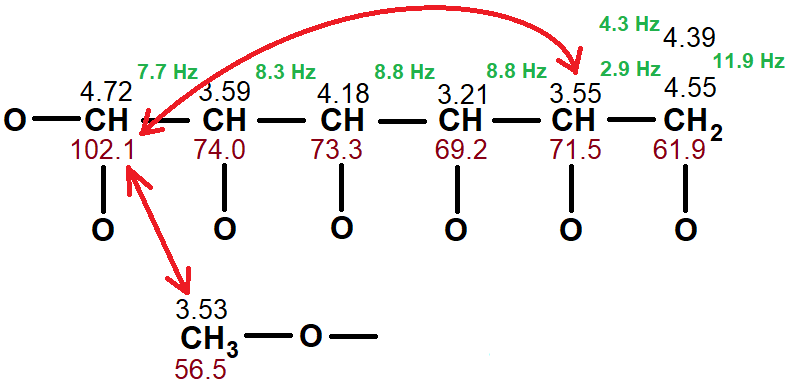
With the open chain as we have it, the H at 4.72 ppm would be five bonds from the carbon at 71.5 ppm, too far to give a correlation. But if the CH at 102.1 ppm were joined through an oxygen to the CH at 3.55 / 71.5 ppm, the distance would drop to three bonds: H–C–O–C. That link would close a six-membered ring of five carbons and one oxygen.
The row of the C at 102.1 ppm. To confirm it, we look for the hydrogens that correlate with that carbon: 4.18, 3.59, 3.55, 3.53 and 3.21 ppm.
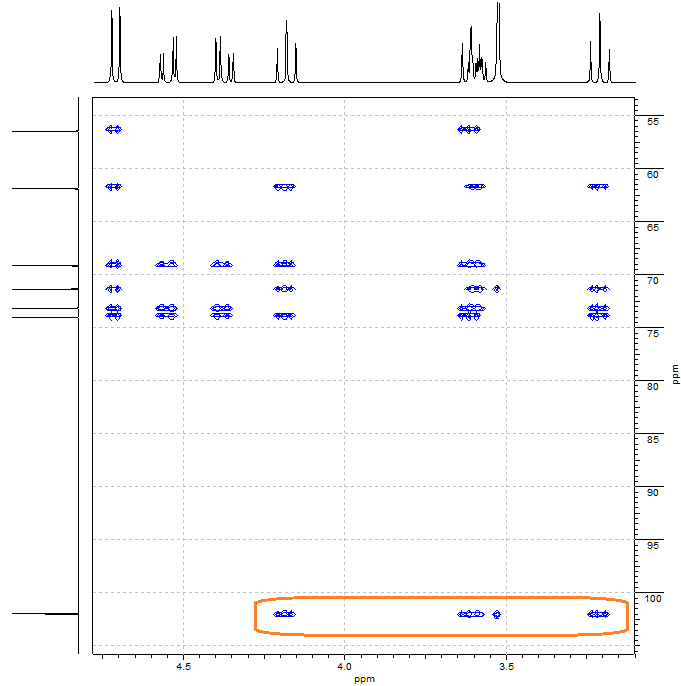
- Those at 3.59 ppm (two bonds) and 4.18 ppm (three bonds) were expected from the chain we already had.
- The one at 3.55 ppm (the CH at 71.5 ppm) is only possible through the ring oxygen, over three bonds. It confirms that the ring-closing oxygen joins these two carbons.
- The one at 3.53 ppm (the OCH3) shows that the methoxy group is bonded to this same carbon: H–C–O–C, three bonds. This answers the third question.
- The one at 3.21 ppm is four bonds away; this spectrum also shows some weak correlations of this kind, such as that of the H at 4.72 ppm with the CH2 at 61.9 ppm.
The structure
With the two shared oxygens in place (the ring oxygen, between the carbons at 102.1 and 71.5 ppm, and the methoxy oxygen), the four remaining oxygens are OH groups: on the carbons at 74.0, 73.3, 69.2 and 61.9 ppm. They are exactly the four exchangeable hydrogens missing from the 1H spectrum.
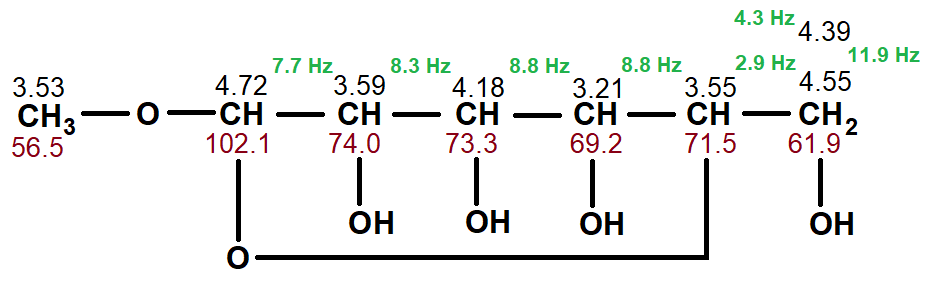
It is a methyl glycoside: a hexose in the form of a six-membered ring (pyranose) with an OCH3 at the anomeric position, the carbon at 102.1 ppm.
The stereochemistry remains, and it comes from the coupling constants we measured in the COSY. All the constants between consecutive ring CH groups (H-1/H-2, 7.7 Hz; H-2/H-3, 8.3 Hz; H-3/H-4 and H-4/H-5, 8.8 Hz) are large. According to the Karplus relationship, all those hydrogens are axial, and all the ring substituents are equatorial. This is the arrangement of glucose with a β anomeric group: the compound is methyl β-glucopyranoside. NMR does not distinguish enantiomers; if it comes from natural glucose, it is methyl β-D-glucopyranoside.
The full sequence has been: 1H and COSY give the hydrogen chains; 13C and HSQC the carbon of each hydrogen; HMBC joins the fragments through the oxygens; and the coupling constants give the stereochemistry.