HSQC case studies
We continue with compound C7H14O6 from the COSY case studies. The 13C spectrum and the HSQC give each hydrogen in the chain its carbon, show that every carbon is bonded to oxygen and make clear how many oxygens must be shared.
The one-dimensional spectra
The 1H and 13C spectra were recorded in D2O on a 400 MHz instrument for 1H (100 MHz for 13C).
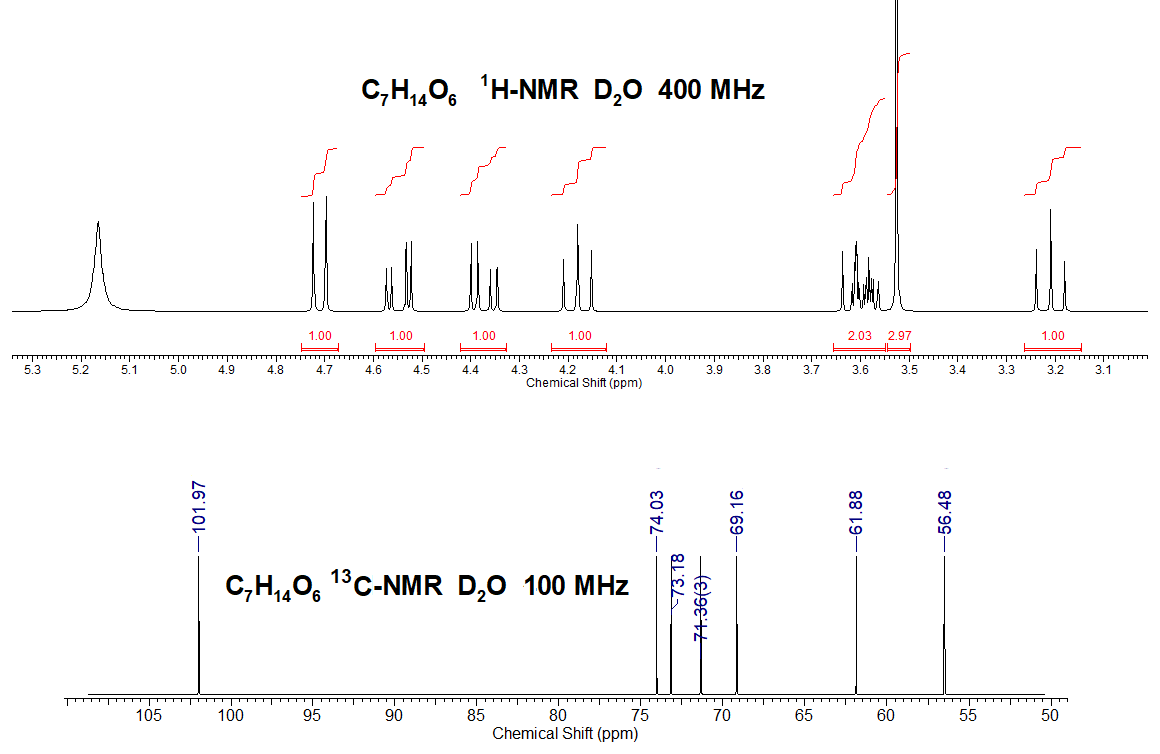
From the 1H spectrum we already knew there is an isolated OCH3 (3.53 ppm) and a chain of five CH groups and one CH2, and that the 4 missing hydrogens are OH groups exchanged with D2O. The 13C spectrum adds two things:
- There are seven signals, one per carbon: all the carbons are different.
- All lie between 55 and 105 ppm, the region of carbons bonded to oxygen. The one at 102.0 ppm, strongly deshielded, belongs to a carbon bonded to two oxygens, such as an acetal carbon.
The HSQC
Let us see which carbon belongs to each hydrogen.
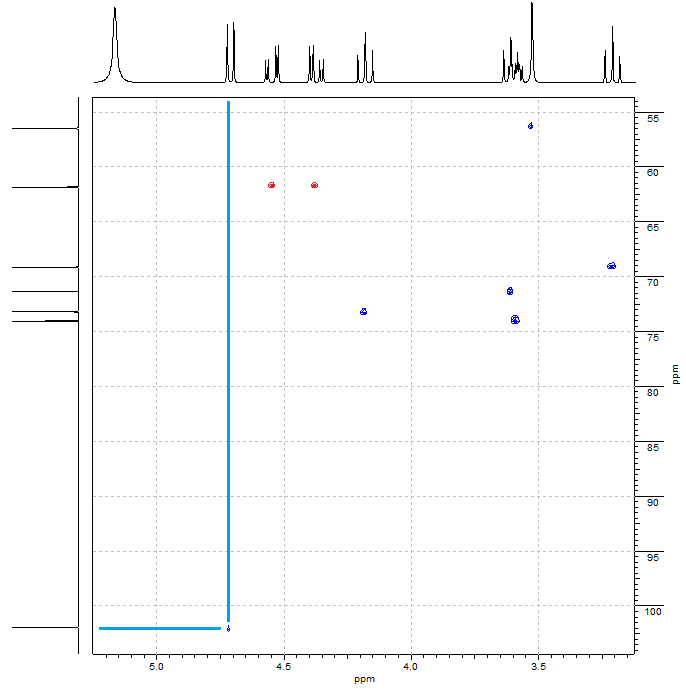
The seven spots read as follows:
| δ 1H (ppm) | δ 13C (ppm) | Group |
|---|---|---|
| 4.72 | 102.1 | CH (two oxygens) |
| 3.59 | 74.0 | CH |
| 4.18 | 73.3 | CH |
| 3.21 | 69.2 | CH |
| 3.55 | 71.5 | CH |
| 4.39 and 4.55 | 61.9 | CH2 (diastereotopic) |
| 3.53 | 56.5 | OCH3 |
Three details:
- The two signals at 4.39 and 4.55 ppm go to the same carbon (61.9 ppm): this confirms they are the two diastereotopic hydrogens of a CH2.
- The HSQC resolves the overlap at 3.53–3.62 ppm: there are three signals there, from three different carbons (74.0, 71.5 and 56.5 ppm).
- In this spectrum the colour code is the opposite of the crotonate one: the CH2 is red and the CH and CH3 groups are blue. That is why the code of each spectrum must always be checked.
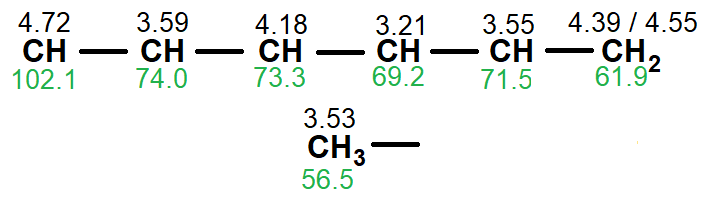
Combining this information with the fragments deduced from the COSY:
Where the oxygens go
Judging by their shifts, all the chain carbons are bonded to oxygen, and the one at 102.1 ppm to two. Putting an oxygen in each position, the correlation map looks like this:
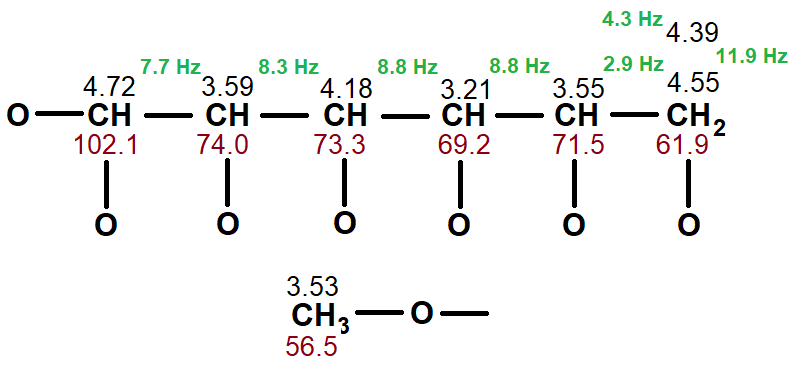
Let us count the oxygens: two on the carbon at 102.1 ppm, one on each of the other five chain carbons and one more in the OCH3. That makes eight positions, but the formula has only six oxygens. So two of them must be shared between two carbons: they are C–O–C bridges. This fits the unsaturation given by the formula: one of those bridges must close a ring.
Two questions remain:
- Which carbon is the OCH3 bonded to?
- Which carbons share the oxygen that closes the ring?
We are very close, but HSQC cannot answer: it only sees C–H bonds. We need a decisive spectrum, that of correlations over more than one bond. We will solve it in the HMBC case studies.
HSQC turns a list of 1H signals into a list of CH, CH2 and CH3 groups with their carbons. Together with COSY it gives the fragments of the molecule; HMBC joins them.