
An unknown drug
Identifying the active ingredient of a medicine is a real problem in quality-control laboratories and in the fight against counterfeits. Unlike an exam problem, the sample is not pure: the tablet or capsule contains excipients. But a suitable solvent and a few spectra are usually enough, and an 80 MHz benchtop spectrometer can solve many cases.
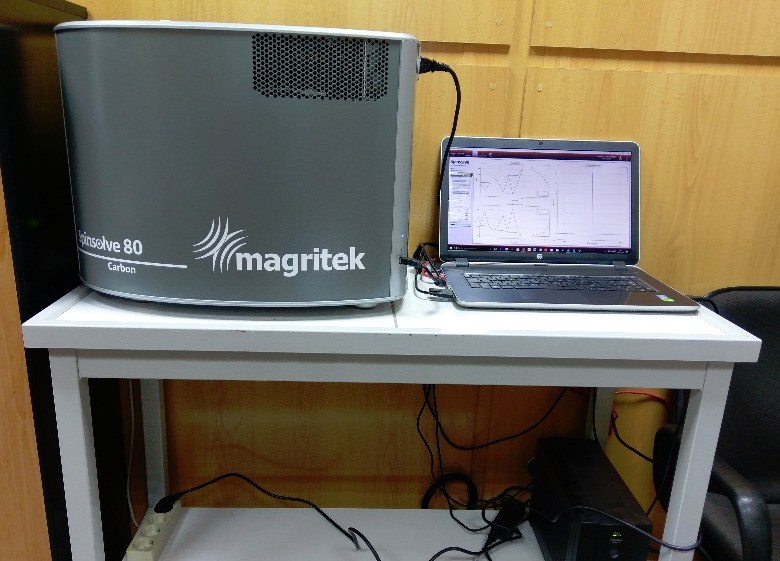 ▶ An unknown drug (in Spanish)
The video shows how a case of this kind is approached. Here we follow the same path with an example of our own.
Preparing the sample
The contents of the capsule are ground and shaken with the deuterated solvent. Most excipients (cellulose, starch, lactose, magnesium stearate, titanium dioxide) are insoluble in CDCl3 and are removed by filtering or letting them settle; the active ingredient, present in amounts of tens or hundreds of milligrams, stays in solution. If it does not dissolve in CDCl3, DMSO-d6 or CD3OD is tried.
The data
| Technique | Data |
|---|---|
| MS | m/z 206 (M+•), 161 (intense). Exact mass: 206.1307 |
| IR | 3300–2500 (very broad band), 1720 (s) cm−1 |
| 13C (CDCl3) | 181.1 (C), 140.9 (C), 137.0 (C), 129.4 (2 CH), 127.3 (2 CH), 45.0 (CH2), 44.9 (CH), 30.1 (CH), 22.4 (2 CH3), 18.1 (CH3) |
| 1H (CDCl3) | ≈ 11.5 (broad s, 1H); 7.22 (d, J = 8.0 Hz, 2H); 7.10 (d, J = 8.0 Hz, 2H); 3.70 (q, J = 7.2 Hz, 1H); 2.45 (d, J = 7.2 Hz, 2H); 1.84 (m, 1H); 1.50 (d, J = 7.2 Hz, 3H); 0.90 (d, J = 6.6 Hz, 6H) |
The solution
Formula. The exact mass corresponds to C13H18O2 (calculated 206.1307), with (26 + 2 − 18)/2 = 5 degrees of unsaturation.
Functional group. The very broad IR band between 3300 and 2500 cm−1, the C=O at 1720 cm−1, the carbon at 181.1 ppm and the broad hydrogen near 11.5 ppm, which disappears on shaking with D2O, indicate a carboxylic acid. The loss of 45 units (206 → 161) in the mass spectrum is the loss of COOH.
Fragments.
- A para-disubstituted benzene ring: two 2H "doublets" (actually an AA′BB′ system), with only four aromatic carbons, two of them quaternary. Together with the C=O it accounts for the 5 degrees of unsaturation.
- An isobutyl group: a 6H doublet (two identical methyls) coupled to a 1H multiplet (1.84 ppm), which in turn couples to a 2H doublet at 2.45 ppm. A CH2 at 2.45 ppm, with no neighbours other than the CH, is bonded to the ring.
- A CH(CH3) fragment: a 1H quartet at 3.70 ppm and a 3H doublet at 1.50 ppm with the same constant. The CH shift shows that it is bonded both to the ring and to the carbonyl.
Joining. In the HMBC, the CH2 hydrogens (2.45 ppm) correlate with the quaternary aromatic carbon at 140.9 ppm and with the CH carbons at 129.4 ppm; the CH at 3.70 ppm, with the carbonyl (181.1), with the other quaternary carbon (137.0) and with the CH carbons at 127.3 ppm. The two substituents are in positions 1 and 4 of the ring.
Structure. It is 2-(4-isobutylphenyl)propanoic acid, ibuprofen. The two carbons at 45.0 (CH2) and 44.9 ppm (CH) almost coincide in the 13C spectrum, but the edited HSQC separates them by their sign.
NMR identifies the compound, but does not tell whether it is a single enantiomer or the racemate: the two enantiomers give identical spectra. Distinguishing them requires a chiral environment (T12). Ibuprofen is sold as the racemate, although its activity is due mainly to the (S) enantiomer.